
Philotes sonorensis
(Felder & Felder, 1865)
Sonoran blue, stonecrop blue
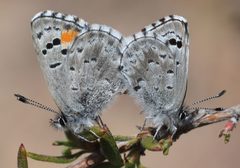
Philotes sonorensis, the Sonoran blue or stonecrop blue, is the sole in the Philotes. This small is found in the southwestern United States and northern Mexico, inhabiting arid rocky environments. The species has a wingspan of 22–25 mm. Larvae are specialized feeders on Dudleya species (stonecrops), boring into leaves. The P. s. extincta from the upper San Gabriel River wash was declared extinct in 1970 after three decades of sampling documented its disappearance.

Pronunciation
How to pronounce Philotes sonorensis: /fiˈloʊtiːz soʊnoʊˈrɛnsɪs/
These audio files are automatically generated. While they are not always 100% accurate, they are a good starting point.
Images
Habitat
Rocky washes, outcrops, and cliffs in desert environments. Associated with stands of Dudleya plants growing in rocky substrates.
Distribution
California, Colorado, and northern Mexico (including Baja California). The extinct P. s. extincta formerly occurred in the upper San Gabriel River wash in the San Gabriel Mountains of southern California.
Diet
Larvae feed on Dudleya , specifically D. cymosa, D. lanceolata, and D. saxosa. have been observed feeding on nectar.
Host Associations
- Dudleya cymosa - larval plantlarvae bore into leaves
- Dudleya lanceolata - larval plantlarvae bore into leaves
- Dudleya saxosa - larval plantlarvae bore into leaves
Life Cycle
Complete with four stages: , larva, pupa, and . Larvae bore into leaves of Dudleya . Chrysalids hibernate under stones during winter.
Behavior
Larvae exhibit specialized feeding by boring into leaves of succulent plants. Chrysalids seek shelter under stones for .
Ecological Role
Specialized herbivore in desert , with tight association to Dudleya stonecrop plants. May serve as as .
Human Relevance
Subject of conservation concern due to localized distribution and specificity. The extinct P. s. extincta represents a documented case of extinction in North America, recognized nearly two decades after its disappearance.
Similar Taxa
- Scolitantides orionClosest relative based on molecular ; distinguished by geographic distribution and plant associations
- Pseudophilotes speciesRelated in same clade; distinguished by wing patterns and genitalia
Sources and further reading
- BugGuide
- Wikipedia
- GBIF taxonomy match
- iNaturalist taxon
- NCBI Taxonomy
- Catalogue of Life
- Could Silver Nanoparticles Be a New Tool to Manage Biting Midges?
- Biting Midges' Overwintering Activity Offers Clues to Persistence of Bluetongue Virus
- Another Study Confirms Mosquitoes, Midges Don't Transmit Coronavirus
- Beware the "Dark Side" of Light Traps
- Oh, Deer! How One Entomologist Works to Improve Wildlife and Livestock Health
- Acanthaceae | Beetles In The Bush