
Lycaena mariposa
(Reakirt, 1866)
Mariposa copper
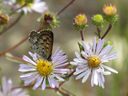
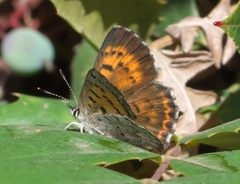
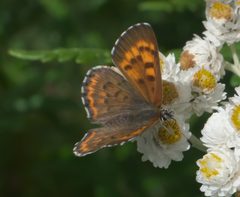
Lycaena mariposa, the mariposa , is a small in the Lycaenidae. It occurs in western North America, where are active in mid-summer. The has a wingspan of 23–28 mm and exhibits the copper-orange coloration typical of its . Larvae feed on specific plants including Vaccinium arbuscula and Polygonum douglasii. Two are recognized: L. m. penroseae and L. m. charlottensis.
Pronunciation
How to pronounce Lycaena mariposa: /laɪˈsiːnə ˌmærəˈpoʊsə/
These audio files are automatically generated. While they are not always 100% accurate, they are a good starting point.
Identification
Images
Habitat
Montane and subalpine regions of western North America. Associated with supporting larval plants Vaccinium arbuscula and Polygonum douglasii, which occur in open, often rocky or shrubby areas.
Distribution
Western Canada and the United States. Documented from Alberta and Saskatchewan in Canada. Range extends through mountainous regions of the western United States.
Seasonality
on wing from mid-July to August. Single brooded with restricted summer period.
Diet
Larvae feed on Vaccinium arbuscula (dwarf bilberry) and Polygonum douglasii (Douglas's knotweed). food sources not specified in available sources.
Host Associations
- Vaccinium arbuscula - larval food plantDwarf bilberry; Ericaceae
- Polygonum douglasii - larval food plantDouglas's knotweed; Polygonaceae
Similar Taxa
- Other Lycaena species in western North AmericaSimilar -orange wing coloration; distinguished by geographic range, period, and subtle differences in wing pattern and size
Sources and further reading
- BugGuide
- Wikipedia
- GBIF taxonomy match
- Catalogue of Life
- All Flights Lead to the Butterfly Summit | Bug Squad
- Robert Michael Pyle, Butterflies and The Dark Divide | Bug Squad
- Butterfly Summit Features UC Davis Expert Art Shapiro | Bug Squad
- Robert Michael Pyle: The Face of Insect Conservation | Bug Squad
- Over a century later, the mystery of the Alfred Wallace’s butterfly is solved | Blog
- Winter Botany Quiz #6 – answers and a checklist | Beetles In The Bush