
Decinea percosius
(Godman, 1900)
double-dotted skipper
Decinea percosius, commonly known as the double-dotted skipper, is a small hesperiid with a wingspan of 22–35 mm. It is native to Middle America and occasionally colonizes southern Texas. are active year-round in tropical regions and from March through November in Texas.
Pronunciation
How to pronounce Decinea percosius: //dɛˈkɪniə pɜːrˈkoʊʃəs//
These audio files are automatically generated. While they are not always 100% accurate, they are a good starting point.
Identification
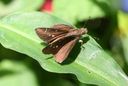
The combination of an angled transparent spot in the forewing and a single small transparent spot on the hindwing upperside distinguishes this from similar skippers. The yellow-brown hindwing underside is also a useful field mark.
Images
Appearance
Wings are dark brown with distinctive transparent spots. The forewing upperside has an angled transparent spot in the . The hindwing upperside has one small transparent spot in the middle. The hindwing underside is yellow-brown.
Habitat
Associated with grassland environments where larval plants occur. Specific preferences are not well documented.
Distribution
Native range extends from Belize north through Mexico. Occasional colonist to the lower Rio Grande Valley in southern Texas, USA.
Seasonality
are on wing from March to November in southern Texas and Mexico. Year-round activity likely occurs in tropical portions of the range.
Diet
Larvae feed on various grasses. feed on flower nectar.
Host Associations
- various grasses - larval food plantspecific grass not documented
Life Cycle
Complete with , larva, pupa, and stages. Detailed descriptions are not available.
Behavior
visit flowers for nectar. No other specific behavioral observations have been documented.
Ecological Role
may contribute to pollination while feeding on nectar. Larvae function as herbivores on grasses.
Human Relevance
No significant economic or cultural importance. Occasionally observed by enthusiasts in southern Texas.
Similar Taxa
- other Decinea speciesshare similar size and general skipper ; distinguished by spot pattern on wings
- other Hesperiinae with transparent wing spotsspot number, position, and wing coloration differ
More Details
Vagrancy
The Texas represents occasional rather than established breeding populations.