
Aguna
Williams, 1927
Species Guides
2- Aguna claxon(Emerald Aguna)
- Aguna mcguirei(McGuire's Aguna)
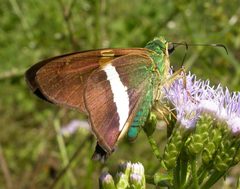
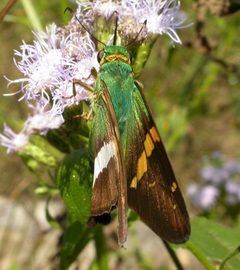
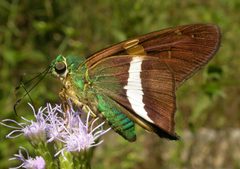
Aguna is a Neotropical of (Hesperiidae) in the Eudaminae. in this genus are associated with Fabaceae plants, particularly Bauhinia species. The genus was established by Williams in 1927 and contains multiple species distributed across tropical and subtropical regions of the Americas.
Pronunciation
How to pronounce Aguna: //ˈæ.ɡuː.nə//
These audio files are automatically generated. While they are not always 100% accurate, they are a good starting point.
Images
Habitat
Neotropical regions including Atlantic Forest remnants in northeastern Brazil. Aguna megacles megacles has been documented in periurban and intraurban areas near the Environmental Protection Area of "Catolé" and "Fernão Velho" in Maceió municipality, Alagoas State.
Distribution
Neotropical Region. Documented from Alagoas State, Brazil (Maceió municipality) for A. megacles megacles. The occurs across tropical and subtropical areas of the Americas.
Host Associations
- Bauhinia pentandra (Fabaceae) - larval plantconfirmed for A. megacles megacles in Alagoas, Brazil
- Bauhinia monandra (Fabaceae) - larval plantconfirmed for A. megacles megacles in Alagoas, Brazil
Life Cycle
Post-embryonic development of A. megacles megacles lasts 46–53.4 days depending on number of larval instars (five or six instars observed). Larvae construct shelters from the first instar onward. In laboratory conditions, pupae preferentially positioned at the base of the cage.
Behavior
Larvae exhibit feeding on Bauhinia . Shelter-building behavior begins in the first instar.