
Bleptina caradrinalis
Guenée, 1854
Bent-winged Owlet, Variable Snout Moth
Bleptina caradrinalis is a small erebid commonly known as the bent-winged owlet or variable snout moth. It was described by Achille Guenée in 1854. The has a broad distribution spanning North America from Nova Scotia to British Columbia and south to Arizona, with additional extending from southern North America through Brazil and throughout the Antilles. are and active during summer months.
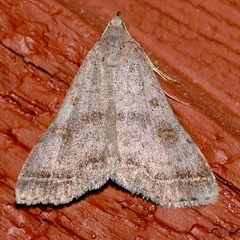
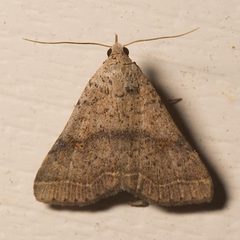
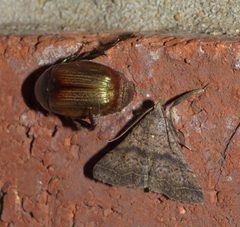
Pronunciation
How to pronounce Bleptina caradrinalis: /ˈblɛptɪnə kæˌrædrɪˈnælɪs/
These audio files are automatically generated. While they are not always 100% accurate, they are a good starting point.
Identification
The bent or angled outer margin of the forewing distinguishes this from many similar herminiine . The combination of moderate size (22–32 mm wingspan), dull brown-gray coloration, and forward-projecting labial palps ('snout') aids recognition. The specific epithet 'caradrinalis' references superficial resemblance to certain Caradrina species. Genitalia examination may be required for definitive identification from closely related Bleptina species.
Images
Appearance
Wingspan 22–32 mm. Forewings with slightly bent or angled outer margin, giving the its . Coloration variable, generally dull brown to grayish-brown with subtle patterning. Hindwings paler than forewings. Body relatively slender with prominent labial palps that project forward like a snout.
Habitat
Deciduous and mixed forests, woodland edges, shrubby areas, and disturbed . Associated with plants including barberry, clover, and hickory. Found from sea level to moderate elevations across its range.
Distribution
North America: Nova Scotia west to British Columbia, south to Arizona. Neotropical range: southern North America south through Central America to Brazil, including the Antilles.
Seasonality
on wing June to August in northern parts of range; timing varies by latitude and elevation. Single or multiple likely depending on geographic location.
Diet
Larvae feed on leaves of barberry (Berberis), clover (Trifolium), and hickory (Carya). feeding habits unrecorded.
Host Associations
- Berberis - larval food plantbarberry
- Trifolium - larval food plantclover
- Carya - larval food planthickory
Life Cycle
Complete with , larval, pupal, and stages. Larvae are leaf-feeders on recorded plants. site unrecorded. stage not confirmed; likely as larva or pupa in temperate regions.
Behavior
are and attracted to light. Larvae feed exposed on leaves of plants. No specialized defensive documented.
Ecological Role
Larval herbivore; contributes to nutrient cycling through leaf consumption. Serves as prey for including birds, bats, and predatory arthropods. No specialized mutualisms documented.
Human Relevance
Minor economic significance; larvae occasionally feed on clover, a forage crop, but not considered a pest. Subject of citizen science documentation through platforms such as iNaturalist.
Similar Taxa
- Bleptina speciesOther Bleptina share similar size, coloration, and wing shape; require genitalia dissection or detailed wing pattern analysis for separation
- Herminiinae gen. spp.Many herminiine share dull brown coloration and 'snout' appearance; forewing margin shape and specific pattern elements distinguish B. caradrinalis
More Details
Nomenclature
Authorship sometimes cited as Guenée, 1852 in error; correct date is 1854 per original description.
Common name variation
'Variable snout ' reflects both the ' color variability and the projecting labial palps characteristic of the Herminiinae.