
Parascotia fuliginaria
(Linnaeus, 1761)
Waved Black
Parascotia fuliginaria, commonly known as the Waved Black, is a small in the Erebidae. Native to Europe, it has been introduced to North America. The is notable for its dark coloration with contrasting yellowish-ochreous lines and its specialized larval diet of fungi and lichens.
Pronunciation
How to pronounce Parascotia fuliginaria: //ˌpærəˈskoʊʃə fjuːˌlɪdʒɪˈnɛəriə//
These audio files are automatically generated. While they are not always 100% accurate, they are a good starting point.
Identification
The combination of blackish fuscous wings with yellowish-ochreous waved lines distinguishes this from similar dark . The waved subterminal line is particularly diagnostic. The wholly black ab. carbonaria variant lacks visible patterning and may require dissection or molecular confirmation for identification. Larvae are recognizable by the orange on the sides and hind pair of each segment, combined with the distinctive white dorsal stripe with black line.
Images
Appearance
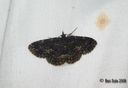
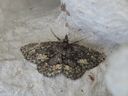
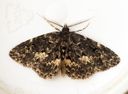
forewings are blackish fuscous with yellowish-ochreous lines edged in black; the outer line is dentate and the subterminal line is distinctly waved. A black mark is present at the end of the . Hindwings match the forewings in coloration and pattern. Wingspan 18–28 mm; forewing length 11–14 mm. Known color variants include ab. flava (pale ochreous wings with blackish fasciae in males, pale yellowish brown in females) and ab. carbonaria (wholly black). Larva is black with a white stripe that is swollen in places and contains a black line; several fine, interrupted, wavy whitish lateral lines; large bearing long hairs, with lateral tubercles and hind pair on each dorsal segment orange; black with yellow lines.
Habitat
Associated with woodland and forested environments where larval fungi occur. Specific microhabitat requirements for are not well documented.
Distribution
Native to Europe, extending east to the Ural Mountains, Armenia, and Asia Minor. Introduced and established in North America. Present in Belgium (including Brussels-Capital, Flemish, and Walloon regions).
Seasonality
fly from June to October; exact timing varies by location.
Diet
Larvae feed on fungi, specifically Fomitopsis betulina and Trametes versicolor, and on lichens. feeding habits are not documented.
Host Associations
- Fomitopsis betulina - larval foodPolypore fungus
- Trametes versicolor - larval foodPolypore fungus
- Lichens - larval foodGeneral group, specific not documented
Life Cycle
Complete with , larval, pupal, and stages. Larval stage described in detail; site and stage not documented in available sources.
Ecological Role
Larvae function as decomposers, feeding on wood-decaying fungi and lichens. Specific impacts have not been quantified.
Human Relevance
No documented economic or medical significance. Occasionally encountered by naturalists and enthusiasts. Introduced status in North America suggests human-mediated , though mechanism and date of introduction are not documented.
Similar Taxa
- Other dark Erebidae mothsSimilar ground coloration, but P. fuliginaria distinguished by yellowish-ochreous waved lines; ab. carbonaria variant lacks pattern and may be confused with other uniformly black
More Details
Color Variants
Three named variants recognized: typical form with blackish fuscous wings and yellowish-ochreous lines; ab. flava (Hormuzaki) from Bukowina with pale ochreous to yellowish brown wings; and ab. carbonaria (Esper) which is wholly black.
Taxonomic History
Originally described as Phalaena fuliginaria by Linnaeus in 1761; later transferred to Parascotia.