
Acsala
Benjamin, 1935
Species Guides
1- Acsala anomala(Rockslide Lichen Moth)
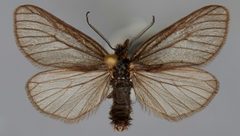
Acsala is a of lichen containing a single , Acsala anomala. The genus belongs to the monotypic subtribe Acsalina within the Erebidae. It is restricted to subarctic regions of western North America, specifically Alaska and Yukon. The genus was established by Foster H. Benjamin in 1935, with the subtribe formally described in 1999.
Pronunciation
How to pronounce Acsala: /ækˈsɑːlə/
These audio files are automatically generated. While they are not always 100% accurate, they are a good starting point.
Identification
Males distinguished by broad wings and small size; females by flightless, narrow-winged condition. Larvae identifiable by barbed setae. Distinguished from other Lithosiini by the combination of male activity, female flightlessness, and subarctic distribution.
Images
Appearance
males have broad wings with a wingspan of 27–28 mm. Adult females possess narrow, reduced wings (stenopterous condition). Wing venation is variable. Larvae have barbed setae. Freshly laid are red-orange, later turning pale orange.
Habitat
Rocky environments supporting lichen growth. Associated with substrates bearing black foliose and crustose lichens.
Distribution
Western subarctic North America: Alaska (United States) and Yukon (Canada).
Diet
Larvae feed on rock-growing lichens, specifically black foliose and crustose forms. Documented food sources include of Buellia, Lecidea, Orphniospora, Parmelia, and Umbilicaria.
Host Associations
- Buellia - foodlichen
- Lecidea - foodlichen
- Orphniospora - foodlichen
- Parmelia - foodlichen
- Umbilicaria - foodlichen
Life Cycle
deposited in single layer on underside of rocks in batches up to thirty. eight to ten days.
Behavior
males are day-active with weak . Adult females are flightless and spend much time under rocks. are laid in batches on rock undersurfaces.
Ecological Role
Larval herbivore on saxicolous lichens. Role in nutrient cycling in subarctic rocky .
Similar Taxa
- Other LithosiiniAcsala distinguished by female flightlessness (stenopterous wings), male activity, and specific subarctic distribution. Most Lithosiini have fully winged females and broader distributions.
More Details
Taxonomic history
and first described by Foster H. Benjamin in 1935. Subtribe Acsalina introduced by Franclemont in 1983 but remained a until formal description by Bendib and Minet in 1999.
Hodges number
Acsala anomala has been assigned Hodges number 8104.1 in the North American numbering system.