
Etainia sericopeza
(Zeller, 1839) Beirne, 1945
Norway Maple Pigmy Moth, Norway maple seedminer
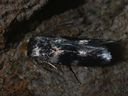
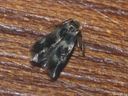
Etainia sericopeza is a minute in the Nepticulidae, commonly known as the Norway Maple Pigmy Moth or Norway maple seedminer. The is native to Europe, ranging from Fennoscandinavia to the Mediterranean, and has been introduced to eastern North America. Larvae develop as seed miners within the samaras of Norway maple (Acer platanoides). The moth was transferred from the Ectoedemia to Etainia based on morphological and molecular studies.
Pronunciation
How to pronounce Etainia sericopeza: /ɛˈteɪniə ˌsɛrɪkoʊˈpiːzə/
These audio files are automatically generated. While they are not always 100% accurate, they are a good starting point.
Identification
Distinguished from other European Nepticulidae by the combination of association with Norway maple and the pale transverse forewing fascia. Similar Etainia louisella and Etainia decentella feed on different Acer species and show subtle wing pattern differences. Examination of genitalia is required for definitive identification; male genitalia feature distinctive valvae structure. The North American introduction can be confirmed by association with Norway maple samaras containing larval mines.
Images
Habitat
Associated with urban and suburban environments, parks, and woodlands where Norway maple is cultivated or naturalized. Also found in native European mixed deciduous forests where Acer platanoides occurs naturally. Larval is strictly within developing samaras of the tree.
Distribution
Native range: Europe from Fennoscandinavia south to the Pyrenees, Italy, and Greece; west to Great Britain, east to Russia and Ukraine. Introduced range: eastern North America, with confirmed records from Ontario, Quebec, Massachusetts, and Delaware. The North American distribution corresponds to the planted range of Norway maple.
Seasonality
active from late May through August in Europe, with peak in June–July. Timing varies with latitude. Larval development occurs during summer as seeds mature. takes place in autumn, with adults emerging the following spring.
Diet
Larva feeds exclusively on developing seeds (samaras) of Norway maple (Acer platanoides). Each larva consumes a single seed, creating a conspicuous blotch mine visible through the seed wing. mouthparts are ; adults do not feed.
Host Associations
- Acer platanoides - larval Exclusive ; larva develops within single samara
Life Cycle
. laid on developing samaras in late spring. Larva mines within seed, passing through three instars. Full-grown larva exits seed in autumn and descends to ground to pupate in soil or leaf litter. Pupal lasts through winter. timed with flowering of tree the following spring.
Behavior
Larvae are sedentary miners, never leaving the seed until maturity. are , active in sunshine, and can be observed running on foliage or flying in short, erratic bursts. Males employ feather-like hindwing androconia to disperse during mate-seeking. Adults occasionally attracted to light.
Ecological Role
Specialized seed of Norway maple. levels typically low, with minimal impact on . Serves as prey for including birds and . The North American population represents a classic example of host-tracking following introduction of the host plant.
Human Relevance
No significant economic impact. Occasionally noted as a curiosity by arborists and naturalists. The North American introduction has been used in studies of insect-plant and invasion . Norway maple itself is considered in parts of North America; the does not contribute to its control.
Similar Taxa
- Etainia louisellaAlso mines Acer seeds, but restricted to Acer pseudoplatanus and A. campestre; forewing fascia position differs slightly
- Etainia decentellaFeeds on Acer ; distinguished by male genitalia and more northerly distribution
- Ectoedemia quadrinotellaSimilar size and wing pattern but feeds on Betulaceae; association is the primary discriminator
More Details
Taxonomic history
Originally described by Zeller in 1839 as Nepticula sericopeza. Transferred to Ectoedemia, then to Etainia in 1945 by Beirne. The Etainia was redefined in 2013 to include former 'Ectoedemia' associated with Acer and related based on molecular .
North American invasion
First detected in North America in the 1970s. The introduction is presumed to be with imported Norway maple planting stock. The has not expanded beyond the range of its tree.