
Epimartyria
Walsingham, 1898
Species Guides
3- Epimartyria auricrinella(Goldcap Moss-Eater)
- Epimartyria bimaculella
- Epimartyria pardella
Epimartyria is a of small, primitive in the Micropterigidae, established by Walsingham in 1898. The genus contains three described : E. auricrinella, E. bimaculella, and E. pardella. These moths represent an ancient lineage of Lepidoptera that retains chewing mouthparts as , a characteristic of the family Micropterigidae.
Pronunciation
How to pronounce Epimartyria: /ˌɛpɪmɑrˈtɪriə/
These audio files are automatically generated. While they are not always 100% accurate, they are a good starting point.
Identification
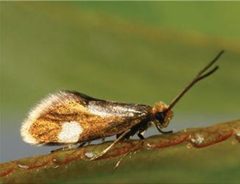
Distinguished from other Micropterigidae by genitalic characters and specific wing pattern elements. E. auricrinella has distinctive gold-tipped forewing . E. bimaculella has two dark spots on the forewings. E. pardella has spotted forewing patterns. Identification to level requires examination of genitalia or wing pattern details.
Images
Habitat
Associated with moist, shaded environments where larval plants (liverworts) occur. include forested areas with suitable bryophyte .
Distribution
North America. E. auricrinella occurs in western North America (California, Oregon). E. bimaculella is known from eastern North America (North Carolina). E. pardella is found in western North America (California, Oregon).
Seasonality
are active in spring and early summer; specific periods vary by and locality.
Diet
Larvae feed on liverworts (Marchantiophyta). consume pollen, having retained the ancestral chewing mouthpart condition.
Host Associations
- Liverworts - larval food plantSpecific not fully documented for all
Life Cycle
Complete with , larva, pupa, and stages. Larvae are associated with liverworts. occurs in silk cases.
Behavior
are and visit flowers to consume pollen. Larvae feed on liverworts in moist microhabitats.
Ecological Role
Pollen consumption by may contribute to minor pollen transfer. Larvae are specialized herbivores on liverworts.
Human Relevance
No significant economic or medical importance. Of interest to lepidopterists studying basal lineages.
Similar Taxa
- MicropterixAlso in Micropterigidae; distinguished by wing venation and genitalic characters
- SabatincaAnother micropterigid ; differs in wing pattern and genitalia
More Details
Evolutionary significance
Micropterigidae, including Epimartyria, represent one of the most basal lineages of living Lepidoptera, providing important insights into the evolutionary transition from chewing to siphoning mouthparts in the order.
Taxonomic history
The was established by Lord Walsingham in 1898 with the description of E. auricrinella. E. pardella was transferred from the genus Micropterix. E. bimaculella was described in 2012 based on specimens from North Carolina.