
Micropterigidae
Herrich-Schäffer, 1855
mandibulate archaic moths
Genus Guides
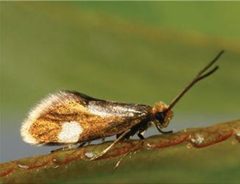
1is the sole in the superfamily Micropterigoidea and suborder Zeugloptera, representing the most primitive extant lineage of Lepidoptera. These small are unique among living Lepidoptera in possessing functional chewing mouthparts rather than a siphoning . feed on pollen, often in , while larvae of at least some feed on liverworts. The family contains approximately 20 living distributed across multiple continents, with a fossil record extending to the Middle-Late Jurassic.
Pronunciation
How to pronounce Micropterigidae: //ˌmaɪkroʊpˈtɛrɪdʒɪdiː//
These audio files are automatically generated. While they are not always 100% accurate, they are a good starting point.
Identification
Distinguished from all other Lepidoptera by the presence of functional and chewing mouthparts in ; all other extant Lepidoptera possess a siphoning . The can be further identified by the unique antennal types (ascoïd sensilla, multiporous sensilla placodea, circular organs) not found in combination elsewhere. Larvae are recognizable by the specialized honeycomb-patterned trunk with fluid-filled chambers.
Images
Habitat
occur in diverse environments including rain forests, coastal areas, and temperate woodlands. Larvae of at least some are associated with bryophytes, particularly the liverwort Conocephalum conicum. Japanese species show strict association with this liverwort, suggesting specialized microhabitat requirements.
Distribution
Disjunct global distribution including: Europe (widespread), North Africa (Maghreb region), Japan (extensive radiation of ~25 ), Far East of Russia (Primorskii Krai), Southeast Asia (Vietnam—first Northern Hemisphere record of Australian Aureopterix), Australia and New Zealand, and New Caledonia. Fossil record extends to Kazakhstan (Middle-Late Jurassic), Myanmar (Cretaceous Burmese amber), Baltic amber (Eocene), and other Cretaceous deposits.
Diet
feed on pollen of herbaceous plants, shrubs, and trees, often in large . Larvae of Japanese feed exclusively on the liverwort Conocephalum conicum. Diet of larvae in other regions remains largely undocumented.
Host Associations
- Conocephalum conicum - larval food plantExclusive for Japanese radiation; liverwort
- herbaceous plants, shrubs, trees - pollen sourcegeneral pollen feeding by
Life Cycle
Early developmental stages remain unknown for many , including the North African Micropterix aureofasciella. Complete documentation is lacking for most of the 's diversity.
Behavior
frequently feed in large on flowers. ability is low, consistent with localized, distributions. No long-distance communication has been demonstrated in studied (Sabatinca spp.); visual cues appear to mediate mate location. Adults are attracted to light.
Ecological Role
function as pollen feeders and likely contribute to pollination. Larvae of at least some are herbivores on liverworts, representing a rare example of bryophyte-feeding among Lepidoptera. The Japanese radiation demonstrates that significant diversification can occur without apparent differentiation.
Human Relevance
Subject of considerable scientific interest as the most primitive living lineage of Lepidoptera, providing insights into the evolutionary origins of the order. Some are considered potentially threatened due to restricted distributions and specificity. No significant economic importance.
Similar Taxa
- AgathiphagidaeAlso a primitive non-glossatan ; distinguished by larval feeding on gymnosperm seeds (Araucaria) rather than pollen-feeding and bryophyte-feeding larvae
- HeterobathmiidaeAnother primitive non-glossatan ; distinguished by feeding on southern beech (Nothofagus) pollen and different larval associations
More Details
Evolutionary significance
retains numerous plesiomorphic traits lost in all other extant Lepidoptera, including functional , separate (not into a ), and homoneurous wing venation. The 's persistence since at least the Jurassic without angiosperm association challenges assumptions about the role of angiosperm radiation in lepidopteran diversification.
Silk composition
Neomicropteryx cornuta produces silk with divergent fibroin composition, lacking fibroin H sequences and showing significant divergence in the putative fibroin L homolog compared to higher Lepidoptera, reflecting the 's basal phylogenetic position.
Speciation pattern
The Japanese radiation of approximately 25 represents the largest known radiation of herbivorous insects without apparent differentiation, with speciation driven primarily by geographic isolation rather than ecological specialization.
Sources and further reading
- BugGuide
- Wikipedia
- GBIF taxonomy match
- iNaturalist taxon
- NCBI Taxonomy
- Catalogue of Life
- New taxa of extant and fossil primitive moths in South-East Asia and their biogeographic significance (Lepidoptera, Micropterigidae, Agathiphagidae, Lophocoronidae)
- New data on Microlepidoptera (Lepidoptera: Micropterigidae, Adelidae, Glyphipterigidae, and Yponomeutidae) from the Far East of Russia
- Sensory Organs on the Antennae of Micropterix calthella L. (Lepidoptera, Micropterigidae)
- Rediscovery of Micropterix aureofasciella Heath, 1986 (Lepidoptera: Micropterigidae) in Algeria after 116 years, with an update on its distribution and morphological notes
- A failed attempt to demonstrate pheromone communication in archaic moths of the genus Sabatinca Walker (Lepidoptera, Micropterigidae)
- Allopatric distribution and diversification without niche shift in a bryophyte-feeding basal moth lineage (Lepidoptera: Micropterigidae)
- Absence of fibroin H sequences and a significant divergence in the putative fibroin L homolog in Neomicropteryx cornuta (Micropterigidae) silk.