
Tolype
Hübner, 1820
Tolype Moths
Species Guides
11- Tolype austella
- Tolype dayi
- Tolype distincta
- Tolype glenwoodii
- Tolype laricis(Larch Tolype Moth)
- Tolype lowriei
- Tolype mayelisae
- Tolype minta(Southern Tolype Moth)
- Tolype nigricaria
Tolype is a of in the Lasiocampidae, Poecilocampinae, established by Jacob Hübner in 1820. within this genus are known for caterpillars bearing urticating (stinging) hairs that can cause skin irritation in humans. At least one species, Tolype innocens, has been documented as a pest of blueberry crops in South America, where larvae feed on leaves and new shoots. The genus exhibits feeding habits, with larvae consuming foliage from both forest plants and agricultural crops.
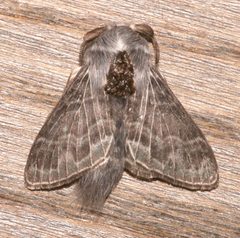
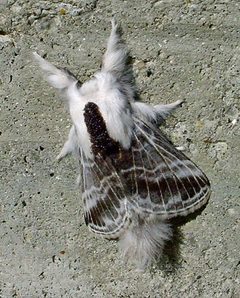
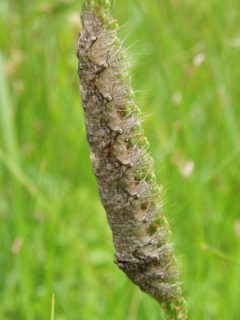
Pronunciation
How to pronounce Tolype: /ˈtɒlɪˌpiː/
These audio files are automatically generated. While they are not always 100% accurate, they are a good starting point.
Images
Habitat
Forest and agricultural plantations; at least one (T. innocens) has been documented in blueberry (Vaccinium ashei) plantations in Brazil. Laboratory rearing has been conducted at 25±1°C, 70±10% relative humidity, and 12-hour .
Distribution
South America: Brazil (Rio Grande do Sul), Argentina, Paraguay, and Uruguay. North American records exist from Vermont and other United States locations based on occurrence data.
Diet
Larvae feed on leaves and new shoots of plants. Documented hosts include blueberry (Vaccinium ashei) and various forest plants; on leaves and sprouts.
Host Associations
- Vaccinium ashei - herbivoreblueberry; leaves and new shoots consumed by larvae
- Forest plants - herbivore on leaves and sprouts of various forest
Life Cycle
Complete with four stages. For T. innocens under laboratory conditions: stage 15.0 days (35.3% viability); larval stage 33.3 days (84.5% viability); pupal stage 20.6 days (100% viability); total egg-to- period 69.2 days with 45% overall viability. Mean time 77 days. occurs in protected locations; eggs are covered by abdominal setae forming a protective physical barrier.
Behavior
Larvae possess that can cause chemical burns and skin irritation in humans, earning the 'burning beast' in Argentina. are laid either individually or in masses (averaging approximately 51 eggs per mass) and are glued together by secretions from colleteric glands, then covered with protective .
Ecological Role
Defoliator of plants; can cause up to 10% defoliation in blueberry plantations. Medical hazard to human harvesters due to , potentially interfering with fruit harvest operations. No direct damage to fruit has been observed.
Human Relevance
Agricultural pest of blueberry crops in South America. pose health risk to farm and harvesters, causing skin irritation and chemical burns. Biological parameters have been studied to inform strategies.
More Details
Etymology
name established by Jacob Hübner in 1820.
Population Dynamics
T. innocens can increase 47 times per with a finite rate of increase of 1.02.
Reproductive Biology
Sex ratio approximately 1:1. Pre-oviposition period averages 6.34 days, oviposition period 12.1 days. Mean 251 per female. longevity approximately 19-20 days.