
Callizzia amorata
Packard, 1876
Gray Scoopwing, gray scoopwing moth
Callizzia amorata, commonly known as the gray scoopwing , is a swallowtail moth in the Uraniidae. It is found across North America from the Pacific coast to the Atlantic. are most frequently observed during late spring and summer months. The is recognized by its distinctive wing posture and patterning.
Pronunciation
How to pronounce Callizzia amorata: /kæˈlɪtsiə æˈmɔːrɑːtə/
These audio files are automatically generated. While they are not always 100% accurate, they are a good starting point.
Identification
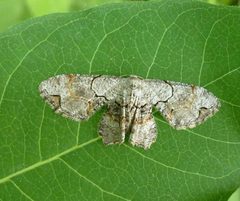
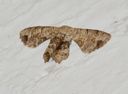
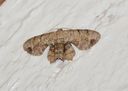
The combination of spread, horizontal forewings with creased hindwings folded over the is distinctive. The black-edged brown triangular marking on the outer margin of each forewing provides a key visual cue for identification. This wing posture differs from many other where wings are typically held roof-like or flat together.
Images
Appearance
have forewings that are held horizontally and spread, while the hindwings are creased and held along or over the . Each forewing bears a black-edged, brown triangle near the outer margin. The overall coloration is gray, consistent with the .
Distribution
Occurs across North America from California and British Columbia in the west to Florida and Nova Scotia in the east. Canadian provincial records include Alberta, Manitoba, and Saskatchewan.
Seasonality
have been reported from February through October, with peak activity from May to August.
More Details
Taxonomic note
GBIF lists the as Epiplema in its match, though Callizzia is the accepted genus in other sources including NCBI Taxonomy and iNaturalist. The status in GBIF is marked as DOUBTFUL.
Observation frequency
The has over 2,000 observations on iNaturalist, indicating it is relatively well-documented for a of this .