
Costaconvexa centrostrigaria
(Wollaston, 1858)
Bent-lined Carpet, Traveller, Bent-line Carpet
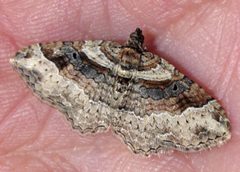
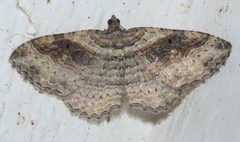
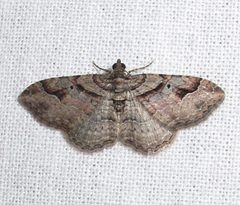
A small geometrid with wingspan 17–23 mm, native to most of North America and introduced to parts of Europe and Atlantic islands. are active across extended or year-round periods depending on latitude. The has two or more annually in most of its range.
Pronunciation
How to pronounce Costaconvexa centrostrigaria: //ˌkɔstəˌkɒnˈvɛksə ˌsɛn.troʊ.strɪˈɡɛəriə//
These audio files are automatically generated. While they are not always 100% accurate, they are a good starting point.
Identification
Distinguished from similar carpet moths by the bent or angled transverse line on the forewing, giving rise to the 'Bent-lined Carpet'. Small size (17–23 mm wingspan) and association with Polygonum plants may aid identification.
Images
Habitat
Associated with supporting Polygonum , the larval plants. Specific habitat preferences beyond host plant presence are not well documented.
Distribution
Native to most of North America except the Arctic. Introduced to Great Britain, the Canary Islands, the Azores, and Madeira. GBIF records confirm presence on multiple Azorean islands including Faial, Flores, Graciosa, Pico, and São Jorge.
Seasonality
on wing May to October in Ontario; March to November in north-eastern North America; year-round in Texas and western North America. Two or more per year.
Diet
Larvae feed on Polygonum . feeding habits are not documented.
Host Associations
- Polygonum - larval plantLarval food source; specific Polygonum not specified in available sources.
Life Cycle
Two or more per year. Specific details on , larval, and pupal stages are not documented in available sources.
Human Relevance
An introduced in Europe and Atlantic islands, potentially of interest for monitoring Lepidoptera. No documented economic or agricultural significance.
Similar Taxa
- Other Costaconvexa speciesShared characteristics; C. centrostrigaria distinguished by the bent forewing line and specific distribution patterns.
- Other Larentiinae carpet mothsSimilar size and patterning; the bent transverse line is diagnostic for C. centrostrigaria.
More Details
Introduction history
Established as an introduced in Great Britain and Macaronesian islands (Canary Islands, Azores, Madeira), suggesting human-mediated across oceanic barriers.
Taxonomic authority
Originally described by Wollaston in 1858.