
Perizoma alchemillata
(Linnaeus, 1758)
Small Rivulet
A small geometrid native to Europe and parts of Asia, introduced to Newfoundland in the mid-20th century and now established in North America. are distinguished from the similar Perizoma affinitata by smaller size and specific wing pattern details. Larvae develop inside seed capsules and feed on flowers of certain Lamiaceae plants.


Pronunciation
How to pronounce Perizoma alchemillata: //pɛˈɹɪ.zə.mə ˌæl.kəˈmɪl.ə.tə//
These audio files are automatically generated. While they are not always 100% accurate, they are a good starting point.
Identification
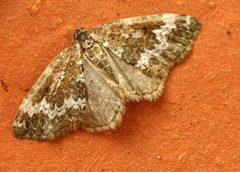
Distinguished from Perizoma affinitata by: smaller overall size; double indentation (versus single) in inner margin of the wing band; clearer, more regular white marks at forewing hindmargin; tendency for reduced pale band on dark hindwing; presence of black dashes on forewing in area. Male and female genitalia provide definitive separation. Form 'peterseni' with expressed white antemedian and widened postmedian bands occurs in Estonia, Scandinavia, Scotland, and as aberration elsewhere.
Images
Habitat
Forests and open areas. In introduced range (Newfoundland), established in various localities across the island including both coastal and inland regions.
Distribution
Native: Europe, Asia Minor, Transcaucasia, Siberia, Altai Mountains. Introduced: Newfoundland (first recorded 1954, Avalon Peninsula; spread to central, western, and southwestern Newfoundland by 1980); mainland North America (first documented occurrence 1982).
Seasonality
active July through August. In Newfoundland, collected 2-31 July 1975 at Tompkins; first Newfoundland record 22 July 1954.
Diet
Larva feeds inside seed capsules and on flowers of Galeopsis tetrahit, Lamium purpureum, and Galeopsis speciosa (Lamiaceae).
Host Associations
- Galeopsis tetrahit - larval food plantseed capsules and flowers
- Lamium purpureum - larval food plantseed capsules and flowers
- Galeopsis speciosa - larval food plantseed capsules and flowers
Life Cycle
Complete with , larva, pupa, and stages. Larval stage characterized by feeding inside seed capsules. Specific timing of developmental stages not detailed in available sources.
Behavior
Larva feeds internally within seed capsules of plants, limiting exposure. has shown substantial range expansion in Newfoundland from initial introduction point over 25-year period (1954-1980).
Ecological Role
Herbivore specializing on Lamiaceae; larval feeding inside seed capsules may reduce seed production of plants. No broader role documented.
Human Relevance
Introduced in North America with documented spread across Newfoundland; subject of entomological study due to invasion significance. No economic or agricultural impacts reported.
Similar Taxa
- Perizoma affinitataVery similar in color and pattern; distinguished by larger size, single (not double) indentation in inner band margin, less regular white hindmargin marks, and more variable pattern. Genitalia provide definitive separation.
More Details
Invasive spread in Newfoundland
First collected 22 July 1954 on Avalon Peninsula. By 1975, common across the peninsula and recorded at Lethbridge (central) and Tompkins (western). By 1980, reached Stephenville and St. Georges in southwest. Absent from Codroy Valley in 1959, 1962, and 1968 surveys, indicating relatively recent arrival in that region. First mainland North America record documented 1982.
Form 'peterseni'
Named form characterized by well-expressed white antemedian band, somewhat widened postmedian white band, and sometimes complete white subbasal band. Prevailing form in Estonia, Scandinavia, and Scotland; occurs as aberration in other localities.