
Eupithecia tripunctaria
Herrich-Schäffer, 1852
white-spotted pug
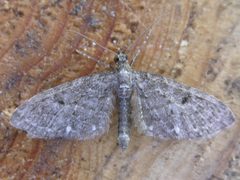
Eupithecia tripunctaria, commonly known as the white-spotted pug, is a small geometrid with a wingspan of 17–21 mm. The is named for distinctive white markings along the wing margins that break from a pale waved line, though these marks may be absent from the hindwings. It occurs across the from Europe through Russia to Japan, as well as in North America from Newfoundland to California. are active from March to September depending on location, and larvae feed on Apiaceae species.


Pronunciation
How to pronounce Eupithecia tripunctaria: //juːpɪˈθiːʃə ˌtrɪpʌŋkˈteəriə//
These audio files are automatically generated. While they are not always 100% accurate, they are a good starting point.
Identification
Distinguished from similar Eupithecia by white marks breaking from the pale waved marginal line on the forewings, though care is needed as these can be subtle or absent on hindwings. The melanistic form f. angelicata is difficult to separate from other dark pug moths. Examination of genitalia is often required for definitive identification of Eupithecia species.
Images
Habitat
Lowland forests, forest edges, and damp meadows. In the Pyrenees and Alps, occurs up to 1800 m elevation.
Distribution
Palearctic: Europe (central Scandinavia to the Alps), Russia, Russian Far East, Siberia, Amur, Baikal region, Japan, Kuril Islands. North America: Newfoundland to British Columbia, south to San Bernardino Mountains in Southern California.
Seasonality
on wing from March to September depending on location.
Diet
Larvae feed on Apiaceae .
Life Cycle
oval with hexagonal depressions in shell . Caterpillars greenish or brownish with clear dark -shaped back spots with bright framing, spot tips directed forward. Pupa brownish with dark green wing ; with two strong and six thin hook bristles.
Behavior
are and attracted to light. Has been observed visiting apple flowers, contributing to nocturnal pollination.
Ecological Role
Herbivore as larva. function as ; documented visiting apple flowers in agricultural settings.
Human Relevance
Documented as a of apple crops. Not known to be an agricultural pest.
Similar Taxa
- Other Eupithecia speciesMany pug moths share narrow wings and similar size; white-spotted marginal markings are the key distinguishing feature but may require expert examination
- Melanistic forms of other geometrid mothsThe dark form f. angelicata lacks diagnostic markings and is difficult to separate from other dark pug without genitalia examination
More Details
Pollination significance
A 2021 study in the Journal of Economic Entomology documented Eupithecia visiting apple flowers and contributing to pollination services in apple production, highlighting that 'pest' and '' roles are not mutually exclusive.