
Eubaphe mendica
(Walker, 1854)
Beggar, Beggar Moth
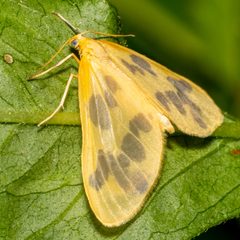
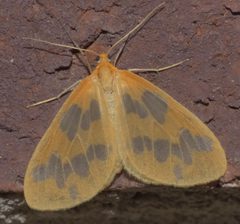
Eubaphe mendica, commonly known as the beggar or beggar , is a small geometrid moth native to eastern North America. The exhibits a to trivoltine with active from late spring through early autumn. Larvae are specialized feeders on maple and violet species. The "beggar" likely derives from the moth's drab, worn-looking appearance.
Pronunciation
How to pronounce Eubaphe mendica: /juːˈbæ.fi ˈmɛn.dɪ.kə/
These audio files are automatically generated. While they are not always 100% accurate, they are a good starting point.
Identification
Distinguished from similar small geometrid moths by its combination of small size (wingspan under 30 mm), drab brownish-gray forewings with indistinct patterning, and pale hindwings. The worn, faded appearance is characteristic. More precise identification requires examination of genitalia or association with larval plants. Similar in the Eubaphe and related larentiines may require dissection for confirmation.
Images
Habitat
Found in deciduous woodlands, forest edges, and areas where plants (maple and violet ) occur. include mixed hardwood forests, riparian corridors, and suburban areas with native vegetation. Specific microhabitat preferences for are not documented.
Distribution
Eastern North America. Documented from Canadian provinces including Alberta, Manitoba, and Saskatchewan, and from the United States including Vermont. The core range appears to be the northeastern and north-central United States and adjacent Canada.
Seasonality
are active from May through September. Three occur per year, with peak periods likely in late spring, mid-summer, and late summer. Exact varies with latitude.
Diet
Larvae feed on of Acer (maple) and Viola (violet). Specific Acer species include sugar maple and possibly other native maples. Specific Viola species are not documented. feeding habits are not described; adults may not feed.
Host Associations
- Acer - larval food plantMaple , including sugar maple
- Viola - larval food plantViolet
Life Cycle
Three per year (trivoltine). stage is not explicitly documented but likely occurs as pupa or larva. are laid on plants. Larvae feed on leaves of maple and violet. occurs in soil or leaf litter. Developmental timing allows for continuous presence from May through September.
Behavior
are and attracted to light. Specific mating or oviposition are not documented. Larvae are external leaf feeders on plants.
Ecological Role
Larvae function as primary consumers, feeding on leaves of maple and violet. Their role in as prey for birds, , and other is likely but not quantified. They contribute to nutrient cycling through herbivory and subsequent decomposition.
Human Relevance
No significant economic or ecological impact. Occasionally encountered by naturalists and enthusiasts. Not considered a pest of ornamental or agricultural plants despite feeding on maple. The "beggar" reflects its unassuming appearance rather than any human interaction.
Similar Taxa
- Eubaphe unicolorSimilar small size and drab coloration; distinguished by more uniform wing color and genitalia
- Other LarentiinaeMany small geometrids share similar appearance; precise identification often requires genital dissection
More Details
Etymology
The specific epithet "mendica" derives from Latin, meaning "beggar" or "beggarly," referring to the 's shabby, worn appearance. The directly translates this epithet.
Taxonomic History
Originally described by Francis Walker in 1854 as Nudaria mendica, later transferred to Eubaphe. The basionym Nudaria mendica is preserved in taxonomic records.