
Nemoria mimosaria
(Guenée, [1858])
White-fringed Emerald, Flanged Looper
Nemoria mimosaria is a small emerald moth in the Geometridae, known by the white-fringed emerald and flanged looper. The was first described by Achille Guenée in 1858. It occurs across much of eastern and central North America, with larvae feeding on a diverse range of woody plants including both deciduous and coniferous trees. are active in early summer and are recognized by their distinctive green coloration with white fringes on the wings.


Pronunciation
How to pronounce Nemoria mimosaria: /nɛˈmɔːriə maɪmoʊˈsɛəriə/
These audio files are automatically generated. While they are not always 100% accurate, they are a good starting point.
Identification
Distinguished from other Nemoria by the combination of white wing fringes and bright green coloration. The small size (26 mm wingspan) and early summer period (mid to late June) help separate it from similar emerald moths. Larvae are identified by their looping movement and lateral body projections, earning the name "flanged looper."
Images
Appearance
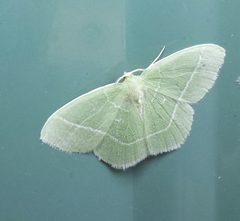
have a wingspan of approximately 26 mm. The forewings and hindwings are bright emerald green with white fringes along the outer margins, giving rise to the . The body is slender and green. Larvae are known as "flanged loopers" due to their distinctive looping locomotion and possess lateral projections or flanges.
Habitat
Associated with mixed woodlands and forest edges where plants occur. Found in supporting Betula papyrifera, Abies balsamifera, Salix, Alnus, and Myrica .
Distribution
North America: Nova Scotia to southeastern Alberta, south to Virginia, Illinois, and Texas. Recorded from Canadian provinces including Alberta, Manitoba, and Saskatchewan, and US states including Vermont.
Seasonality
are on wing from mid to late June. Larval stage occurs prior to adult , likely in spring and early summer.
Diet
Larvae feed on various deciduous shrubs and trees as well as conifer trees. Documented plants include Betula papyrifera (paper birch), Abies balsamifera (balsam fir), Salix (willows), Alnus (alders), and Myrica asplenifolia (sweetfern). feeding habits are not documented.
Host Associations
- Betula papyrifera - larval food plantpaper birch
- Abies balsamifera - larval food plantbalsam fir
- Salix - larval food plantwillows
- Alnus - larval food plantalders
- Myrica asplenifolia - larval food plantsweetfern
Life Cycle
Complete with , larva, pupa, and stages. Larvae are present in spring and early summer, feeding on foliage. Adults emerge in mid to late June. stage is not documented in available sources.
Behavior
Larvae exhibit characteristic looping locomotion typical of Geometridae. No other specific are documented.
Ecological Role
Larval herbivore on woody plants; contributes to nutrient cycling in forest . Specific ecological functions beyond general herbivory are not documented.
Human Relevance
No significant documented economic or cultural importance. Occasionally encountered by observers and photographers due to its attractive green coloration. Not known to be a pest .
Similar Taxa
- Other Nemoria speciesSimilar green coloration, but distinguished by white wing fringes and specific timing
- Other Geometrinae (emerald moths)Share green coloration but differ in wing pattern, fringe color, size, or geographic range
More Details
Taxonomic Note
The was originally described as Aplodes mimosaria by Guenée in 1858 (sometimes cited as 1857). The basionym reflects its previous placement in the Aplodes before transfer to Nemoria.