
Nemoria arizonaria
(Grote, 1883)
emerald moth
Nemoria arizonaria is a North American emerald in the Geometridae, first described by Augustus Radcliffe Grote in 1883. The exhibits remarkable phenotypic plasticity in its larvae, which develop distinct camouflage morphs depending on diet: catkin-feeding larvae resemble oak catkins, while leaf-feeding larvae mimic twigs. display seasonal dimorphism, with summer and winter/spring forms differing in wing markings; the summer form was formerly described as a separate species, Nemoria aemularia. The moth is restricted to canyon in the southwestern United States at elevations of 4,000–8,000 feet.
Pronunciation
How to pronounce Nemoria arizonaria: //nɛˈmɔːr.i.ə ˌæ.rɪˈzoʊ.nɛəriə//
These audio files are automatically generated. While they are not always 100% accurate, they are a good starting point.
Identification
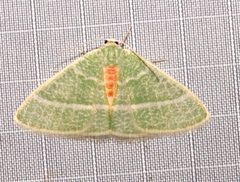
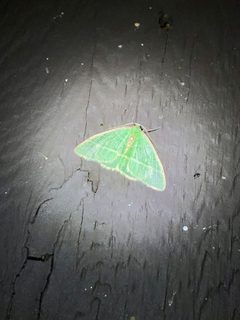
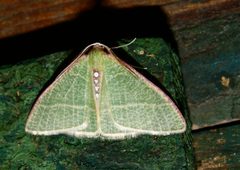
Distinguished from other North American Nemoria by its exceptionally broad white post-medial line. The summer form (formerly N. aemularia) is identified by the white and purple-red costal markings on the forewing. The winter/spring form lacks these costal markings. Among southwestern emerald moths, the combination of broad post-medial line, yellow terminal line, and white wing fringe is diagnostic. Larval identification requires knowledge of plant : golden, fuzzy larvae with small projections indicate catkin-feeding individuals; smooth grey-green larvae indicate leaf-feeding individuals.
Images
Habitat
Restricted to canyon in mountainous regions at elevations between 4,000 and 8,000 feet. Associated with oak-dominated vegetation. frequently observed resting on windows and screens of buildings in the Southwest United States.
Distribution
Southwestern United States: Arizona, New Mexico, southern California, and the Davis Mountains of Texas. The summer form (aemularia) has been documented only in Arizona.
Seasonality
occur in two seasonal forms. The winter/spring form appears earlier in the year; the summer form appears later. Exact periods not specified in available sources. Larvae present during periods when oak catkins (spring) or leaves (summer) are available.
Diet
Larvae feed exclusively on oaks (Quercus). Spring larvae consume oak catkins (flowers/pollen); summer larvae consume oak leaves and twigs. feed on nectar.
Host Associations
- Quercus - larval food plantcatkins in spring, leaves and twigs in summer
Life Cycle
hatch into larvae that feed for several weeks before pupating. Larval phenotype determined entirely by diet: catkin-feeding larvae develop golden, fuzzy, projection-covered morphs; leaf-feeding larvae develop smooth grey-green twig-mimicking morphs. emerge from pupae, mate, lay eggs, and die shortly thereafter. Two seasonal adult forms exist, with the summer form developing under warmer conditions.
Behavior
Larvae exhibit diet-induced phenotypic plasticity that is irreversible once expressed. This represents the first documented case in Lepidoptera where diet alone, rather than or temperature, determines larval . are attracted to artificial structures, commonly resting on windows and screens.
Ecological Role
Larvae function as herbivores on oak vegetation, with seasonal shifts in feeding location (catkins versus leaves). Their phenotypic plasticity in camouflage represents an anti- that has been subject to . The contributes to pollination as nectar-feeders.
Human Relevance
Subject of significant scientific research due to its unique diet-dependent phenotypic plasticity, making it a model organism for studying developmental plasticity and evolution. occasionally encountered by residents of the Southwest United States when attracted to building windows and screens. No known economic importance.
Similar Taxa
- Nemoria aemulariaFormerly considered a separate , now recognized as the summer form of N. arizonaria based on rearing experiments by Noel McFarland (1988) showing that N. arizonaria produce N. aemularia under summer conditions. Distinguished by white and purple-red forewing markings.
- Other Nemoria speciesMany North American Nemoria share emerald green coloration, but N. arizonaria is distinguished by its broader post-medial line and specific wing pattern elements. The contains 15 recognized with overlapping ranges in some areas.
Misconceptions
The summer form was long misidentified as a distinct (Nemoria aemularia) due to pronounced seasonal dimorphism in wing pattern. This was corrected only after controlled rearing experiments demonstrated their conspecificity.
More Details
Phenotypic plasticity mechanism
Research by Erick Greene demonstrated that tannin in oak leaves triggers the twig-morph phenotype, while catkin chemistry induces the catkin-morph. Unlike most polymorphic Lepidoptera where light or temperature cues induce morph change, N. arizonaria relies exclusively on dietary chemical cues. This synchronizes larval appearance with seasonal changes in plant structure, enhancing against avian .
Genetic buffering
The has been studied as a model for genetic buffering—the capacity to maintain consistent phenotype despite genetic and environmental variation, while retaining potential for phenotypic change when buffering breaks down. This may explain how a single produces radically different larval morphs.