
Dichorda iridaria
(Guenée, 1857)
showy emerald moth
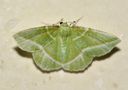
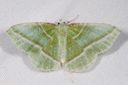
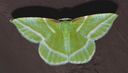
Dichorda iridaria is a small emerald moth in the Geometridae. have a wingspan of 25–28 mm and display characteristic green coloration. The is broadly distributed across eastern and central North America, with larvae feeding on sumacs (Rhus spp.) and poison ivy (Toxicodendron radicans). Two are recognized: the nominate form ranging from Texas to Quebec, and D. i. remotaria found in the southeastern coastal plain.
Pronunciation
How to pronounce Dichorda iridaria: /dɪˈkɔːrdə ɪˈrɪdəriə/
These audio files are automatically generated. While they are not always 100% accurate, they are a good starting point.
Identification
are recognized by their small size (wingspan 25–28 mm) and bright green coloration typical of emerald moths. The can be distinguished from similar green geometrids by its specific wing pattern and body proportions, though precise diagnostic characters require examination of genitalia or reference to regional identification guides.
Images
Habitat
Associated with supporting larval plants, including open woodlands, forest edges, and areas with sumac thickets. are attracted to ultraviolet light sources at night.
Distribution
Eastern and central North America: recorded from Alabama, Arkansas, Florida, Georgia, Illinois, Indiana, Iowa, Kentucky, Maryland, Massachusetts, Mississippi, New Hampshire, New Jersey, New York, North Carolina, Ohio, Oklahoma, Ontario, Pennsylvania, Quebec, South Carolina, Tennessee, Texas, Virginia, West Virginia, and Wisconsin.
Seasonality
have been observed at ultraviolet light in late summer (August) in Missouri. Specific period data across the range is limited.
Diet
Larvae feed on Rhus , including Rhus typhina (staghorn sumac) and Rhus copallina (winged sumac), as well as Toxicodendron radicans (poison ivy). feeding habits are not documented.
Life Cycle
Complete with , larval, pupal, and stages. Larval development occurs on plants; specific details of site and number of per year are not documented.
Behavior
are and attracted to ultraviolet light. Larval includes feeding on foliage of plants.
Ecological Role
Larval herbivore on sumac and poison ivy; specific ecological impacts or interactions are not documented.