
Antepione imitata
Edwards, 1884
Antepione imitata is a geometrid of the Ennominae, first described by Henry Edwards in 1884. It occurs in the southwestern United States and likely extends into northern Mexico. The is closely tied to riparian canyon at elevations up to 1,830 meters. exhibit a complex multi-voltine with three distinct periods correlated with regional rainfall patterns.
Pronunciation
How to pronounce Antepione imitata: /ˌæntɪˈpaɪoʊni ɪˈmɪtəˌtə/
These audio files are automatically generated. While they are not always 100% accurate, they are a good starting point.
Identification
Distinguished from congeneric by genitalia ; a 2012 revision of the Antepione established diagnostic characters separating A. imitata from A. thisoaria and related . External appearance alone may not be sufficient for reliable identification.
Images
Appearance
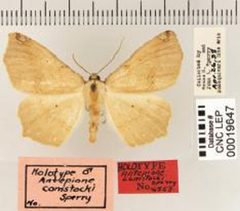
Wingspan 35–37 mm. Specific coloration and pattern details not documented in available sources.
Habitat
Riparian canyons, stream corridors, and associated moist woodland edges. Strongly associated with watercourse environments in otherwise arid regions. Elevational range extends to 1,830 meters.
Distribution
Western Texas, Colorado, and New Mexico through southern Arizona. Probable occurrence in northern Mexico. GBIF records confirm presence in Middle America and North America.
Seasonality
Three annually in southeastern Arizona and southwestern New Mexico: strong early April–early May; weaker flight late June–July; strong flight mid-August–early October following monsoonal rains.
Diet
Larvae feed on Ribes aureum (golden currant).
Host Associations
- Ribes aureum - larval food plantDocumented larval ; riparian shrub matching preference.
Life Cycle
Multi-voltine with three per year in core range. Specific details of , larval, and pupal stages not documented.
Behavior
activity strongly synchronized with monsoonal rainfall patterns, with post-rain in mid-August representing a major peak.
Ecological Role
Herbivore in riparian ; specific ecological functions (pollination, prey base) not documented.
Human Relevance
No documented economic or cultural significance. Subject of taxonomic research on geometrid .
Similar Taxa
- Antepione thisoariaCongeneric with potentially overlapping range; distinguished by male genitalia and subtle external differences per 2012 revision.
- Pionenta ferrisataFormerly placed in Antepione; separated into distinct Pionenta based on structural differences including wing venation and genitalia.
More Details
Taxonomic History
A 2012 revision by Ferris reorganized the , described the new genus Pionenta, and clarified boundaries using genitalia .
Flight Pattern Drivers
The bimodal strong pattern (spring and late summer) with intervening weaker period reflects to southwestern North American precipitation regimes, particularly the Arizona monsoon.