
Nematocampa baggettaria
Ferguson, 1993
Baggett's spanworm moth
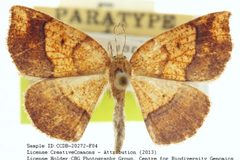
Nematocampa baggettaria, commonly known as Baggett's spanworm , is a small geometrid moth described by Ferguson in 1993. It is restricted to the southeastern United States, with confirmed records from Florida, Georgia, Louisiana, and North Carolina. The species exhibits in forewing length, with active during the warmer months.
Pronunciation
How to pronounce Nematocampa baggettaria: //ˌnɛmətoʊˈkæmpə ˌbæɡɪˈteəriə//
These audio files are automatically generated. While they are not always 100% accurate, they are a good starting point.
Identification
May be distinguished from other Nematocampa by geographic distribution and , though specific diagnostic characters require examination. The small size and southeastern U.S. range help narrow identification possibilities. Definitive identification likely requires genitalic dissection or comparison with type material.
Images
Appearance
Small with forewing length of 7–8 mm in males and 7–9 mm in females. As a member of the spanworm moth group, the larval stage likely exhibits the characteristic looping locomotion typical of Geometridae caterpillars, though specific larval for this is not documented in available sources.
Distribution
Southeastern United States: Florida, Georgia, Louisiana, and North Carolina. GBIF records confirm presence in North America.
Seasonality
are active from April to September, with the period spanning late spring through summer.
Similar Taxa
- Other Nematocampa speciesCongeneric may overlap in range and require careful morphological or molecular examination for separation; N. baggettaria is distinguished by its specific southeastern distribution and description date (1993).
More Details
Taxonomic history
Described by Douglas C. Ferguson in 1993, making it a relatively recently described within the diverse Geometridae .
Observation rarity
As of available sources, the has few documented observations (iNaturalist reports 7 observations), suggesting it may be genuinely rare, undercollected, or cryptic in habits.