
Euchlaena johnsonaria
(Fitch, 1870)
Johnson's Euchlaena Moth
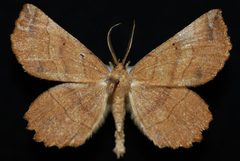
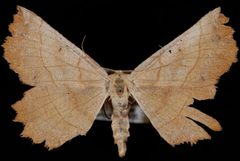
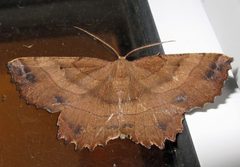
A medium-sized geometrid with a wingspan of approximately 32 mm. are active from May through August. The occurs across much of North America in deciduous wooded . Larvae feed on a documented range of deciduous trees and shrubs including dogwood, willow, spirea, blueberry, elm, ash, and birch.
Pronunciation
How to pronounce Euchlaena johnsonaria: /juːˈklɪniə dʒɒnsəˈnɛəriə/
These audio files are automatically generated. While they are not always 100% accurate, they are a good starting point.
Identification
Distinguished from other Euchlaena by geographic range and association with deciduous woodland . The two (johnsonaria and minoraria) may differ in size or wing pattern, though specific diagnostic features require examination of or authoritative keys.
Images
Appearance
have a wingspan of about 32 mm. The exhibits two recognized : the nominate E. j. johnsonaria and E. j. minoraria, described by Hulst in 1886.
Habitat
Deciduous wooded areas. Occupies forested environments with broadleaf tree and shrub cover.
Distribution
North America. Recorded from southern coastal British Columbia east to Nova Scotia, south to New Jersey, Missouri, and Oregon. Additional records from Alberta, Manitoba, and Saskatchewan in Canada, and Vermont in the United States.
Seasonality
are on wing from May to August. period spans early summer through late summer.
Diet
Larvae feed on various deciduous trees and shrubs: Cornus (dogwood), Salix (willow), Spiraea, Vaccinium (blueberry), Ulmus (elm), Fraxinus (ash), and Betula (birch) . feeding habits are not documented.
Host Associations
- Cornus - larval food plantdogwood
- Salix - larval food plantwillow
- Spiraea - larval food plant
- Vaccinium - larval food plantblueberry
- Ulmus - larval food plantelm
- Fraxinus - larval food plantash
- Betula - larval food plantbirch
Life Cycle
Complete with , larva, pupa, and stages. Specific details of egg-laying, larval instars, sites, and stage are not documented in available sources.
Behavior
are attracted to light. activity pattern inferred from light-trapping records.
Ecological Role
Larvae function as folivores on deciduous woody plants. Specific ecological interactions beyond herbivory are not documented.
Human Relevance
No documented economic or cultural significance. Occasionally observed by citizen scientists during -lighting events and bioblitzes.
Similar Taxa
- Other Euchlaena species-level similarity in wing shape and pattern; require examination of genitalia or geographic/ context for definitive identification
- Other Geometridae in EnnominaeShared characteristics; E. johnsonaria distinguished by specific plant associations and documented range
More Details
Subspecies
Two recognized: Euchlaena johnsonaria johnsonaria (Fitch, 1870) and Euchlaena johnsonaria minoraria (Hulst, 1886). The latter was described by George D. Hulst in 1886.
Taxonomic History
First described by Asa Fitch in 1870. The specific epithet 'johnsonaria' presumably honors an individual named Johnson, though the etymology is not explicitly documented in available sources.