
Metanema inatomaria
Guenée, 1857
Pale Metanema Moth, pale metanema, yellow-lined thorn
Metanema inatomaria is a geometrid with a broad North American distribution spanning and temperate regions from western Canada to the eastern United States. The is recognized by its relatively small size and pale coloration with subtle yellowish markings. Larvae are associated primarily with poplar and willow species, reflecting a specialization typical of many ennomine geometrids. occurs during late spring and early summer.
Pronunciation
How to pronounce Metanema inatomaria: //ˌmɛtəˈnɛmə ˌɪnətəˈmɛəriə//
These audio files are automatically generated. While they are not always 100% accurate, they are a good starting point.
Identification
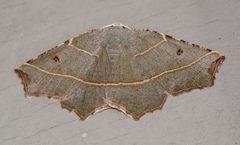
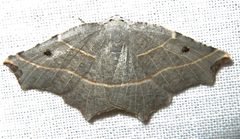
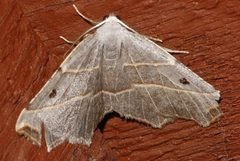
Distinguished from similar pale geometrid moths by the combination of small size (25–36 mm wingspan), pale ground color with subtle yellowish linear markings, and the presence of fine, wavy transverse lines on the forewings. The lacks the strong angular markings or prominent discal spots found in many related Ennominae. Genital examination may be required for definitive separation from .
Images
Appearance
have a wingspan of 25–36 mm. The forewings are pale grayish to yellowish with fine, wavy transverse lines and a faint yellowish tint along certain lines, contributing to the 'yellow-lined thorn.' The hindwings are similarly pale and relatively unmarked. The body is slender and matches the wing coloration. The overall appearance is delicate and cryptic against bark or foliage.
Habitat
Associated with riparian corridors, wetlands, and moist woodlands where plants occur. Found in both and temperate forest zones, including aspen parkland, mixedwood forests, and riverine . Elevation range spans lowland to subalpine zones within its distribution.
Distribution
North America: east-central British Columbia, southern Northwest Territories, Yukon, east to Nova Scotia, south to Mississippi, Texas, and Arizona. Canadian provinces with confirmed records include Alberta, Manitoba, and Saskatchewan. Present throughout much of the forest and adjacent temperate regions of the United States and southern Canada.
Seasonality
are active from late May to mid-July. Single-brooded with in most of its range.
Diet
Larvae feed primarily on Populus (poplars, aspens, cottonwoods) and occasionally on Salix species (willows).
Host Associations
- Populus - primary larval main food source
- Salix - secondary larval occasional use
Life Cycle
Complete with , larval, pupal, and stages. Larvae are present during summer months, feeding on foliage. stage not explicitly documented in sources but presumed to be pupal based on typical ennomine . Adults emerge in late spring.
Ecological Role
Larval herbivore on deciduous woody plants, contributing to nutrient cycling and serving as prey for and . plant specificity suggests potential role in of early-successional hardwood .
Human Relevance
No significant economic or medical importance. Occasionally encountered by naturalists and enthusiasts. Used as an for riparian and wetland quality in some ecological monitoring contexts.
Similar Taxa
- Other Metanema species share similar size range and pale coloration; require genital dissection or detailed wing pattern analysis for separation
- Pale-colored Ennominae (e.g., Lomographa, Cabera)similar overall appearance and size; distinguished by wing pattern details, particularly the presence and arrangement of transverse lines and discal spots
More Details
Taxonomic note
Authorship sometimes cited as Guenée, [1858] in some sources due to publication date conventions, but Guenée, 1857 is widely accepted.
Nomenclatural stability
has remained in Metanema since original description; no significant taxonomic revisions or synonymy noted.