
Esperia sulphurella
(Fabricius, 1775)
Sulphur Tubic
A small in the Oecophoridae with a wingspan of 12–16 mm. are primarily day-flying but also attracted to light traps at night. The has one per year, with adults active in April and May. Larvae develop inside silken tubes within dry rotting wood.
Pronunciation
How to pronounce Esperia sulphurella: //ɛsˈpɪəriə sʌlˈfjʊərəla//
These audio files are automatically generated. While they are not always 100% accurate, they are a good starting point.
Identification
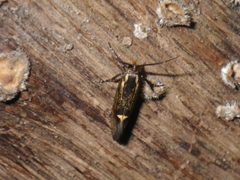
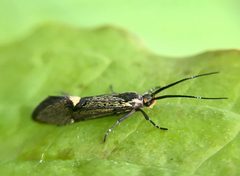
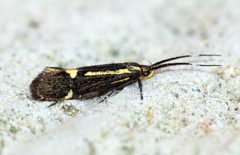
have rich brown forewings flecked with bright yellow ; many yellow scales are grouped to form a triangle at the trailing edge of each forewing, creating a diamond shape when the wings are held together. Females additionally show a pronounced yellow streak along the wing. The combination of small size, day-flying habit, and distinctive yellow-brown wing pattern separates it from most similar Oecophoridae.
Images
Habitat
Woodland and garden sites with dead wood present. Larvae inhabit silken tubes inside dry rotting wood, including dead trunks of coniferous and deciduous trees, stacked wood piles, and fence posts. Not found where wood contacts wet ground.
Distribution
Widely distributed across the UK, common in the Netherlands and Belgium, with scattered records throughout Europe. Introduced to the west coast of the United States.
Seasonality
active April and May; one per year.
Diet
Larvae have been observed feeding on rotting wood and associated fungi.
Life Cycle
One annually. lay in bark crevices. Larvae live in silken tubes inside dry rotting wood, where they develop before .
Behavior
Primarily day-flying; also come to light at night.
Human Relevance
sequenced from a specimen collected in Oxfordshire, UK; genome assembly 453.2 Mb with 30 chromosomal pseudomolecules including Z . The serves as a reference genome for Oecophoridae and gelechioid moths.