
Polyhymno acaciella
Busck, 1900
A small gelechiid described by August Busck in 1900. The is restricted to southwestern North America and exhibits distinctive wing patterning with bold white markings on dark brown forewings. Larvae are specialized feeders on sweet acacia (Acacia farnesiana).
Pronunciation
How to pronounce Polyhymno acaciella: /ˌpɔlɪˈhɪmnoʊ əˌkeɪʃiˈɛlə/
These audio files are automatically generated. While they are not always 100% accurate, they are a good starting point.
Identification
Distinguished from other Polyhymno by the specific configuration of white markings on the forewings: the broad central spindle-shaped band combined with the converging streaks at the apex and the costal cilia markings. The yellowish-gray patch is a useful diagnostic feature. Larval association with Acacia farnesiana provides additional identification support in areas where this plant occurs.
Images
Appearance
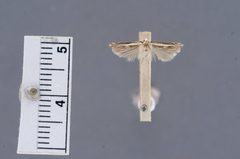
Small with wingspan 12.5–14 mm. Forewings dark mouse brown with a prominent broad spindle-shaped longitudinal white band running from base to beyond the . A short white longitudinal streak occurs between this band and the edge, beginning at mid-wing and fading outward into the dorsal cilia. At the apex of the central white band, three white streaks converge toward a common point just before the wing apex—one below and two above. Three short nearly perpendicular white streaks in the costal cilia also converge to this point, which is marked by a lighter yellowish-gray patch. Hindwings uniformly dark gray. Larvae very dark, nearly black, with black .
Habitat
Associated with stands of sweet acacia (Acacia farnesiana), the larval plant. In the southwestern United States, this corresponds to riparian areas, desert washes, and grassland-woodland transitions where this acacia grows.
Distribution
Southwestern North America: Oklahoma, Texas, Arizona, and California. Records suggest a distribution centered on the Chihuahuan and Sonoran Desert regions with eastern extension into the southern Great Plains.
Diet
Larvae feed on Acacia farnesiana (sweet acacia). feeding habits unknown.
Host Associations
- Acacia farnesiana - larval Larvae feed on this plant
Life Cycle
Complete with larval stage feeding on Acacia farnesiana. Specific details of and timing not documented.
Ecological Role
As a herbivore on Acacia farnesiana, larvae contribute to the associated with this plant in southwestern North American .
Similar Taxa
- Other Polyhymno speciesShare similar body plan and wing venation, but differ in the specific pattern and arrangement of white markings on the forewings; P. acaciella is distinguished by the spindle-shaped central band and converging streaks
More Details
Etymology
The specific epithet 'acaciella' references the larval plant Acacia, indicating the close association between this and its acacia host.