
Coleotechnites milleri
(Busck, 1914)
Lodgepole Needleminer
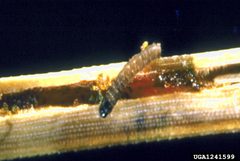
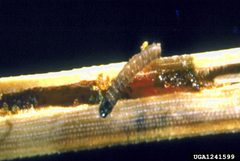
Coleotechnites milleri, commonly known as the lodgepole needleminer, is a small gelechiid native to western North America. The was described by August Busck in 1914 and is characterized by its distinctive black-and-white forewing pattern with raised tufts. The suggests an association with lodgepole pine (Pinus contorta), though specific relationships require confirmation. The moth has a documented wingspan of 12–15 mm.
Pronunciation
How to pronounce Coleotechnites milleri: /ˌkɔ.li.oʊ.tɛkˈniːtiːz ˈmɪl.ə.ri/
These audio files are automatically generated. While they are not always 100% accurate, they are a good starting point.
Identification
Distinguished from other Coleotechnites by the combination of: (1) four small tufts of raised black scales on the forewing (one on middle of , one at end of cell, two below on fold), (2) large poorly defined black costal spot beyond middle with smaller spot before middle, and (3) strongly irregular black suffusion concentrated on costal and areas. The specific pattern of raised tufts is particularly diagnostic within the . Similar species with black-and-white forewing patterns lack this precise arrangement of scale tufts.
Images
Distribution
Western United States and Canada. Specific states/provinces not documented in available sources.
Host Associations
- Pinus contorta - probableInferred from 'lodgepole needleminer'; direct evidence not confirmed in available sources
Similar Taxa
- Other Coleotechnites speciesShare black-and-white forewing patterns and raised tufts, but differ in specific arrangement, number, and position of tufts; C. milleri distinguished by four tufts in precise positions
More Details
Taxonomic History
Described by August Busck in 1914, a prominent early American lepidopterist who described numerous North American microlepidoptera.
Etymology
Specific epithet 'milleri' honors an individual named Miller, though the exact identity of the namesake is not documented in available sources.