
Agnippe prunifoliella
(Chambers, 1873)
Skunk Twirler
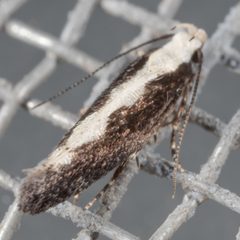
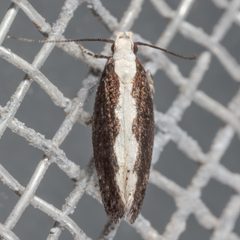
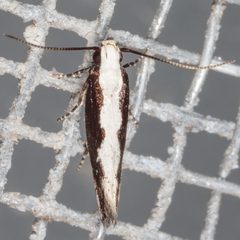
Agnippe prunifoliella is a small gelechiid known by the Skunk Twirler. The occurs across much of North America, with records spanning from southern Canada through the eastern and central United States. are recognized by distinctive forewing patterning with contrasting dark and white areas. The species is a herbivore, with larvae feeding on wild plum.
Pronunciation
How to pronounce Agnippe prunifoliella: //æɡˈnɪp.i pruː.nɪˌfoʊˈliː.ɛl.ə//
These audio files are automatically generated. While they are not always 100% accurate, they are a good starting point.
Identification
Forewings dark greyish brown with white along margin; the color boundary is scalloped, with two or three white teeth or processes extending into the brown area, including one near the cilia opposite a costal white streak. cilia dusky silvery dusted with dark brown. Hindwings pale yellowish fuscous.
Images
Distribution
North America: recorded from Alabama, Alberta, Arizona, Arkansas, British Columbia, California, Florida, Illinois, Indiana, Kansas, Kentucky, Louisiana, Maine, Maryland, Mississippi, North Carolina, Oklahoma, Quebec, South Carolina, Tennessee, Texas, and West Virginia.
Diet
Larvae feed on Prunus americana (American plum).
Host Associations
- Prunus americana - larval food plantwild plum
Similar Taxa
- Agnippe evippeellaformerly confused; A. prunifoliella distinguished by specific forewing pattern with scalloped white-brown boundary
More Details
Taxonomic history
Originally described as Evippe prunifoliella by Chambers in 1873; later transferred to Agnippe. The 'Skunk Twirler' refers to the distinctive color pattern.