
Keiferia lycopersicella
(Walsingham, 1897)
Tomato Pinworm
Keiferia lycopersicella, the tomato pinworm, is a gelechiid and significant agricultural pest of Solanaceae crops. Native to warm regions of the Americas, it has expanded its range through greenhouse production and international trade. The completes seven to eight annually in favorable climates. Larvae are leaf miners and fruit borers, causing direct damage to tomatoes, eggplants, and potatoes. communicate via , with synthetic lures used for monitoring and management.
Pronunciation
How to pronounce Keiferia lycopersicella: //ˌkaɪ.fɛɹ.i.ə ˌlaɪ.kə.pɚˈsɪ.sɛl.ə//
These audio files are automatically generated. While they are not always 100% accurate, they are a good starting point.
Identification
Distinguished from other Keiferia by association with Solanaceae and geographic distribution. Larval damage—silken tents on leaf undersides with entry tunnels into leaves, stems, or fruits—is characteristic. may be identified to by genitalia ; species confirmation requires association with host plant or molecular analysis. Similar gelechiid leaf miners lack the specific tent-spinning on Solanaceae.
Images
Appearance
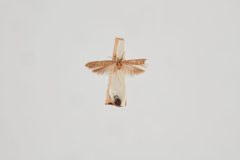
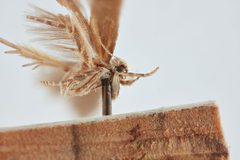
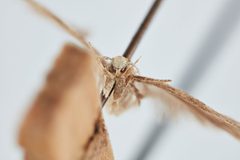
Small with wingspan of 9–12 mm. have narrow, pointed forewings characteristic of Gelechiidae. Coloration not explicitly described in available sources; likely cryptic gray-brown typical of the .
Habitat
Warm temperate to tropical agricultural regions. Thrives in open field production of solanaceous crops in Mexico, southern United States, and Caribbean. Established in protected greenhouse environments in cooler regions including Delaware, Mississippi, Missouri, Pennsylvania, and Virginia.
Distribution
Native to warm areas of North America, Central America, and Caribbean: Mexico, California, Texas, Georgia, Florida, Hawaii, Cuba, Hispaniola, Bahamas. Expanded to greenhouses in Delaware, Mississippi, Missouri, Pennsylvania, Virginia. Established in Europe: mainland Italy. Widespread in Central America ( Rica, El Salvador, Guatemala, Honduras, Nicaragua, Panama, Bermuda, Trinidad and Tobago) and South America (Bolivia, Colombia, Ecuador, Guyana, Peru, Venezuela). Also reported in Canada (Ontario), Jamaica, and Haiti.
Seasonality
Seven to eight per year in warm climates. Activity year-round in tropical and greenhouse environments; seasonal in temperate outdoor .
Diet
Larvae feed exclusively on Solanaceae: Lycopersicon esculentum (tomato), Solanum melongena (eggplant), Solanum tuberosum (potato), Solanum carolinense, Solanum xanthii, Solanum umbelliferum, Solanum bahamense. do not feed; mouthparts reduced or non-functional.
Host Associations
- Solanum lycopersicum - larval primary ; 'tomato pinworm' derives from this association
- Solanum melongena - larval eggplant
- Solanum tuberosum - larval potato
- Solanum carolinense - larval wild
- Solanum xanthii - larval wild
- Solanum umbelliferum - larval wild
- Solanum bahamense - larval wild
Life Cycle
Seven to eight annually in favorable climates. stage lasts at least 5 days; viability for declines after 3 days. Young larvae spin silken tents on leaf undersides, then tunnel into leaves. Later instars may enter stems or fruits. site not explicitly described in available sources. and mating synchronized with scotophase.
Behavior
Young larvae construct protective silken tents on leaf undersides, using these as shelter while creating entry tunnels. Male exhibit oriented upwind to female sources during dark periods (scotophase). -mediated enables monitoring using synthetic lures.
Ecological Role
Herbivore and agricultural pest of Solanaceae crops. serve as for , particularly Trichogramma pretiosum and Trichogramma brassicae, which have been evaluated for . rates of 40–50% observed in controlled conditions.
Human Relevance
Major economic pest of tomato, eggplant, and potato production. Larval leaf mining and fruit boring reduce yield and marketability. Subject to programs using Trichogramma wasps; T. pretiosum recommended at -to- ratios of 1:1 to 10:1 for greenhouse management. lures used for monitoring and timing of control interventions.
Similar Taxa
- Tuta absolutaAlso a gelechiid pest of tomato with larval mining ; distinguished by geographic origin (South America, expanding globally), lack of silken tent construction, and different chemistry
- Other Keiferia speciesAll congeneric with documented are Solanaceae ; K. lycopersicella distinguished by specific host range and distribution; K. azapaensis recently described from Asteraceae host represents exception in
More Details
Biological Control
Trichogramma pretiosum and T. brassicae parasitize 40–50% of in controlled conditions. T. pretiosum causes significantly higher egg mortality than T. brassicae. success decreases at 28°C compared to 20–25°C, and declines with egg age beyond 3 days.
Pheromone Chemistry
Female-produced contains (E)-4-tridecenyl acetate and (E)-4-tridecen-1-ol as major components. Synthetic elicit oriented male response.
Ozone Interactions
-plant suitability is modified by atmospheric ozone exposure, affecting chemical of plant-herbivore interactions.
Sources and further reading
- BugGuide
- Wikipedia
- GBIF taxonomy match
- iNaturalist taxon
- NCBI Taxonomy
- Catalogue of Life
- Keiferia lycopersicella . [Distribution map].
- Sex Pheromone Biology of the Adult Tomato Pinworm, Keiferia lycopersicella (Walsingham)
- EVALUATION OF COMMERCIALLY PRODUCED TRICHOGRAMMA SPP. (HYMENOPTERA: TRICHOGRAMMATIDAE) FOR CONTROL OF TOMATO PINWORM, KEIFERIA LYCOPERSICELLA (LEPIDOPTERA: GELECHIIDAE), ON GREENHOUSE TOMATOES
- Keiferia azapaensis sp. nov., the first representative of the New World micromoth genus Keiferia Busck (Lepidoptera, Gelechiidae) associated with a member of Asteraceae
- Ozone-induced changes in host-plant suitability: Interactions ofKeiferia lycopersicella andLycopersicon esculentum