
Filatima pseudacaciella
(Chambers, 1872)
Dusky-backed Filatima Moth
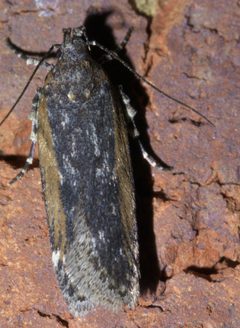
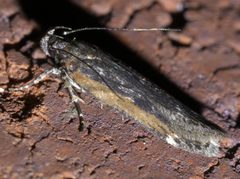
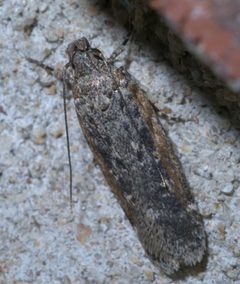
Filatima pseudacaciella is a gelechiid known as the Dusky-backed Filatima Moth. Its larvae are specialized feeders on black locust (Robinia pseudacacia), and have been documented utilizing both external feeding and occupying existing leaf mines created by the related Macrosaccus robiniella. The species is widely distributed across eastern and central North America, with records extending from California to the Atlantic coast and north into Ontario.
Pronunciation
How to pronounce Filatima pseudacaciella: /fɪˈlætɪmə sjuːdəkəˈsiːɛlə/
These audio files are automatically generated. While they are not always 100% accurate, they are a good starting point.
Identification
The dark purplish-brown forewings with distinctive ocherous-white costal streaking and paired small white spots (costal and ) separate this from other Filatima. The specific association with Robinia pseudacacia and the documented larval habit of occupying Macrosaccus robiniella mines provide additional diagnostic context where plants are present.
Images
Habitat
Associated with supporting black locust (Robinia pseudacacia), including forests, woodlands, and disturbed areas where this tree occurs.
Distribution
North America: recorded from California, Illinois, Indiana, Kansas, Kentucky, Louisiana, Maine, Massachusetts, Mississippi, New Hampshire, New York, Ohio, Oklahoma, Ontario, Tennessee, Vermont, and West Virginia.
Diet
Larvae feed on leaves of Robinia pseudacacia. They have been observed feeding within existing mines of Macrosaccus robiniella and also feeding externally on leaf tissue.
Host Associations
- Robinia pseudacacia - larval food plantblack locust
- Macrosaccus robiniella - facultative mine associatelarvae observed feeding within existing mines of this , but also feed externally
Behavior
Larvae exhibit flexible feeding , utilizing both pre-existing leaf mines and external leaf surfaces.
Similar Taxa
- Macrosaccus robiniellaSimilar association with Robinia pseudacacia and overlapping ; distinguished by being a primary with different and larval
More Details
Nomenclature
Originally described as Depressaria pseudacaciella by Chambers in 1872, later transferred to Filatima.