
Chionodes formosella
(Murtfeldt, 1881)
spring oak leafroller
Chionodes formosella, commonly known as the spring oak leafroller, is a small gelechiid found in eastern North America. The is named for its larval habit of rolling or tying oak leaves. It is associated primarily with oak species, particularly those in the red oak group. The moth has a wingspan of approximately 16 mm.
Pronunciation
How to pronounce Chionodes formosella: //kaɪˈoʊ.nəˌdiːz fɔr.moʊˈsɛl.lə//
These audio files are automatically generated. While they are not always 100% accurate, they are a good starting point.
Identification
The specific wing pattern and genitalia characteristics distinguish this from other Chionodes, though detailed identification requires reference to specialized gelechiid literature. The and association with oak leaf-rolling in spring may aid in field recognition.
Images
Habitat
Deciduous forests and woodlands containing oak , particularly those dominated by or including red oaks.
Distribution
Eastern North America, ranging from Nova Scotia to southwestern Manitoba, south to Florida. Records also exist from Manitoba, Canada.
Seasonality
Larvae are active in spring, coinciding with oak leaf . period is not explicitly documented in available sources.
Diet
Larvae feed on oak (Quercus), particularly the red oak group including Quercus rubra and Quercus velutina, and also Quercus alba. Quercus velutina and Quercus alba have been recorded as plants. Ostrya virginiana (hophornbeam) has also been recorded as a host.
Host Associations
- Quercus rubra - larval red oak
- Quercus velutina - larval black oak
- Quercus alba - larval white oak
- Ostrya virginiana - larval hophornbeam; recorded
Life Cycle
Larvae develop in spring, feeding on oak leaves. The specific site and number of per year are not documented in available sources.
Behavior
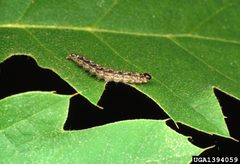
Larvae roll or tie oak leaves, creating shelters for feeding and development.
Ecological Role
Herbivore on oak and hophornbeam; leaf-rolling creates temporary microhabitats that may be used by other organisms.
Similar Taxa
- Other Chionodes speciesMany Chionodes are small, brownish gelechiids requiring genitalia dissection or for definitive identification; some also feed on oak.
- Other oak-feeding leafrollersSeveral Lepidoptera include that roll oak leaves; larval and genitalia are needed for separation.