
Ornativalva erubescens
(Walsingham, 1904)
Ornativalva erubescens is a gelechiid described by Lord Walsingham in 1904. It is distributed across North Africa, the Middle East, and into southwestern North America. The is characterized by distinctive forewing coloration combining whitish ochreous, bright rosy red, and olive-grey pattern elements. have been recorded in multiple months, suggesting extended or multivoltine periods.
Pronunciation
How to pronounce Ornativalva erubescens: /ɔrˌna.tiˈval.va e.ruˈbɛs.kɛns/
These audio files are automatically generated. While they are not always 100% accurate, they are a good starting point.
Identification
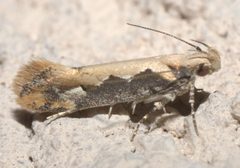
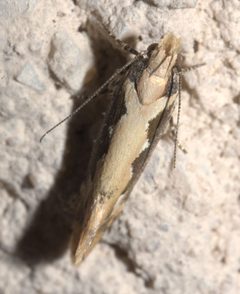
The combination of bright rosy red costal suffusion, olive-grey band with rectangular projections, and specific pattern of brownish fuscous distinguishes this from other Ornativalva. The oblique blackish spot at the end of the olive streak and the narrow black streak on the flexus are additional diagnostic features. The iridescent grey-brown hindwings contrast with the more vividly patterned forewings.
Images
Appearance
Forewings whitish ochreous with bright rosy red suffusion along to two-thirds from base. Olive-grey band between these colors, extending to end of , with two darker rectangular projections downward into paler area. Oblique blackish spot at end of streak, followed by whitish ochreous space with narrow brownish fuscous lower margin. Narrow short black streak on flexus. Two small brownish fuscous within basal third of pale costal area; three larger aggregations on costa and costal cilia in outer third. Two similar scale groups in cilia below apex. Hindwings iridescent grey with brownish tinge.
Distribution
North Africa (Morocco, Algeria, Tunisia, Libya, Egypt, Sudan), Middle East (Israel, Saudi Arabia, Iran), South Asia (Pakistan), and southwestern United States.
Seasonality
recorded on wing in January, May, August, and November, indicating activity across multiple seasons.
More Details
Taxonomic History
Originally described by Thomas de Grey, 6th Baron Walsingham, in 1904.