
Isophrictis magnella
(Busck, 1903)
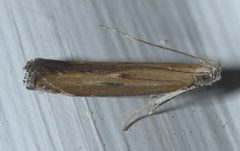
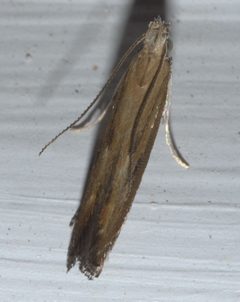
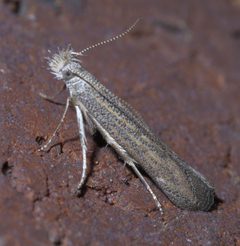
Isophrictis magnella is a gelechiid described by August Busck in 1903. It is recorded across a broad North American range spanning from California to Ontario and Tennessee. The is associated with the plant Hazardia squarrosa, on which its larvae feed. are small moths with distinctive wing patterning featuring yellowish gray forewings marked by black spots, dashes, and white marginal lines.
Pronunciation
How to pronounce Isophrictis magnella: /ˌaɪsəˈfrɪktɪs mæɡˈnɛlə/
These audio files are automatically generated. While they are not always 100% accurate, they are a good starting point.
Identification
Distinguished from similar gelechiid moths by the combination of: yellowish gray forewing ground color (not brown or ochreous); outer two-thirds of costal edge white (not uniformly colored); specific arrangement of black markings—small fold spot plus two elongated white-edged dashes on middle of wing that may coalesce into single line; and distinctive white patterning in cilia with four costal dashes and three pencils. The 15.5–16.5 mm wingspan is moderately small for the . Similar Isophrictis lack this exact configuration of white marginal lines and cilia pencils.
Images
Appearance
Small with wingspan of 15.5–16.5 mm. Forewings yellowish gray with outer two-thirds of costal edge white. Small black spot present on fold. Two elongated black white-edged dashes on middle of wing, sometimes continuous forming one uninterrupted black line. Thin oblique white line runs from fourth of outward to termen. Above this, four white dashes in costal cilia; opposite, a white line emitting three white pencils into dorsal cilia. Hindwings dark gray.
Habitat
Associated with supporting its larval plant Hazardia squarrosa, which grows in coastal scrub, chaparral, and dry open slopes in western North America. Specific microhabitat preferences are not documented.
Distribution
Recorded from California, Colorado, Maryland, Massachusetts, Oklahoma, Ontario (Canada), and Tennessee. Distribution records also include Alberta, Canada. The spans a broad longitudinal range across North America from the Pacific coast to the Atlantic seaboard and north into Canada.
Diet
Larvae feed on Hazardia squarrosa (Asteraceae). feeding habits are not documented.
Host Associations
- Hazardia squarrosa - larval sole documented plant
Ecological Role
Larval herbivore on Hazardia squarrosa; specific ecological impacts or interactions are not documented.
Human Relevance
No documented economic importance or conservation concern. Occasionally recorded by naturalists and enthusiasts.
Similar Taxa
- Isophrictis speciescongeneric share general gelechiid but differ in forewing pattern elements—specifically the configuration of white costal margins, black dashes, and cilia pencils
- Other Aristoteliinae members may resemble in size and general form but differ in wing pattern details, particularly the distinctive white marginal lines and cilia pencils of I. magnella
More Details
Taxonomic history
Described by August Busck in 1903 based on North American specimens. The has remained in the Isophrictis without subspecific division.