
Deltophora sella
(Chambers, 1874)
Black-spotted Twirler
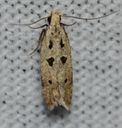
Deltophora sella is a small gelechiid with a broad distribution across the southern and western United States. are active during most of the year, with records spanning March through September and November. The comprises three recognized with geographically restricted ranges: the nominate subspecies in the southeastern and south-central states, D. s. atacta in southwestern Texas, and D. s. californica in California.

Pronunciation
How to pronounce Deltophora sella: //dɛlˈtɒfərə ˈsɛlə//
These audio files are automatically generated. While they are not always 100% accurate, they are a good starting point.
Identification
The combination of small size (5–7 mm forewing length), geographic distribution in the southern and western United States, and seasonal activity from spring through late autumn may help distinguish this from . identification requires geographic knowledge: D. s. sella occurs in North Carolina, Florida, Arkansas, and Texas; D. s. atacta is restricted to southwestern Texas; D. s. californica occurs in California.
Images
Distribution
United States: North Carolina, Florida, Arkansas, Texas (including southwestern Texas), and California. Records also reported from Alberta, Canada, though these may represent vagrant or misidentified specimens given the primary U.S. distribution.
Seasonality
active March through September, with additional records in November. This extended period suggests multiple or continuous in favorable climates.
More Details
Subspecies
Three are recognized based on geographic distribution: Deltophora sella sella (North Carolina, Florida, Arkansas, Texas), Deltophora sella atacta (Meyrick, 1927) from southwestern Texas, and Deltophora sella californica Sattler, 1979 from California.
Taxonomic History
Originally described as Gelechia sella by Chambers in 1874, later transferred to Deltophora. The D. s. atacta was described by Meyrick in 1927, and D. s. californica by Sattler in 1979.