
Anacampsis nonstrigella
Busck, 1906
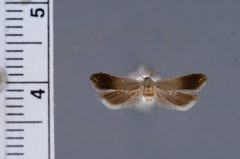
Anacampsis nonstrigella is a small gelechiid described by August Busck in 1906. It is known from a limited range in the eastern United States. The is distinguished by its contrasting wing coloration with dark olive basal forewings and blackish brown areas.
Pronunciation
How to pronounce Anacampsis nonstrigella: //ˌænəˈkæmpsɪs nɒnstrɪˈɡɛlə//
These audio files are automatically generated. While they are not always 100% accurate, they are a good starting point.
Identification
The combination of small size (15 mm wingspan), dark olive basal forewings sharply contrasting with blackish brown third, and white cilia on otherwise dark hindwings separates this from other Anacampsis. The golden-brown at the forewing apex provide an additional diagnostic mark. Similar Anacampsis species lack this specific pattern of contrasting wing zones and white hindwing cilia.
Images
Appearance
A small with wingspan approximately 15 mm. Forewings: basal two-thirds dark olive, third deep blackish brown with scattered golden-brown near the apex. Hindwings: dark purplish fuscous with white cilia.
Distribution
Recorded from Pennsylvania, Indiana, Kentucky, and Maine in the eastern United States. GBIF distribution records confirm presence in the US.
Similar Taxa
- Other Anacampsis speciesSimilar small gelechiid moths in the same , but distinguished by the specific wing color pattern of A. nonstrigella: dark olive basal two-thirds of forewing contrasting with blackish brown apex, plus white cilia on hindwings.
More Details
Taxonomic history
Described by August Busck in 1906, a prominent American entomologist who described numerous North American microlepidoptera.
Observation frequency
As of source data, 61 observations recorded on iNaturalist, indicating it is infrequently encountered or underreported.