
Anacampsis levipedella
(Clemens, 1863)
Silver-dashed anacampsis
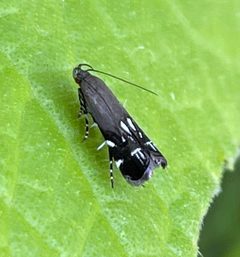
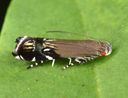
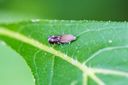
Anacampsis levipedella is a gelechiid known as the silver-dashed anacampsis. It was described by James Brackenridge Clemens in 1863 and is widely distributed across eastern and central North America. The is recognized by distinctive white markings on dark brownish forewings.
Pronunciation
How to pronounce Anacampsis levipedella: /ˌænəˈkæmpsɪs ˌlɛvɪpəˈdɛlə/
These audio files are automatically generated. While they are not always 100% accurate, they are a good starting point.
Identification
Distinguished from by the specific pattern of white markings: two costal streaks with associated longitudinal dashes beneath them, particularly the triangular second costal streak perpendicular to the . The cupreous line and darker half of forewing are additional diagnostic features. Similar Anacampsis lack this precise arrangement of white dashes and streaks.
Images
Appearance
Forewings dark brownish with cupreous (coppery) sheen. Basal half paler than half. Two short oblique white streaks on : first about middle of wing, second midway between first and apex, perpendicular to costa and nearly triangular. Beneath first costal streak, two short longitudinal white dashes flanking wing fold. Beneath second costal streak, two parallel longitudinal white dashes. Hindwings dark brownish.
Distribution
Eastern and central North America: recorded from Alabama, Florida, Georgia, Illinois, Indiana, Iowa, Kentucky, Maryland, Massachusetts, Mississippi, New Jersey, New York, North Carolina, Ohio, Oklahoma, Tennessee, Texas, Virginia, West Virginia, Wisconsin, and Vermont.
Similar Taxa
- Other Anacampsis species share general body plan and dark coloration but differ in specific pattern of white forewing markings; A. levipedella uniquely shows two costal streaks with paired longitudinal dashes beneath each
More Details
Etymology
Specific epithet 'levipedella' from Latin 'levis' (smooth) + 'ped-' (foot) + diminutive '-ella', possibly referring to smooth or reduced leg characteristics
Taxonomic history
Original description by Clemens (1863) has remained stable; no recorded synonymy or subspecific classification