
Anacampsis argyrothamniella
Busck, 1900
Anacampsis argyrothamniella is a small gelechiid described by August Busck in 1900. It is known from a restricted range in the southeastern United States, with confirmed records from Florida and Georgia. The is associated with the plant Argyrothamnia blodgettii, on which its larvae feed by tying leaves together.
Pronunciation
How to pronounce Anacampsis argyrothamniella: //ˌænəˈkæmpsɪs ˌɑːrɡɪroʊˈθæmnɪˌɛlə//
These audio files are automatically generated. While they are not always 100% accurate, they are a good starting point.
Identification
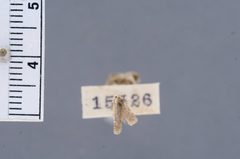
The specific pattern of white markings on the forewings is diagnostic: three discal dots with one below the fold at mid-wing and two above farther out, plus the characteristic outwardly angulated white fascia near the apex. Similar Anacampsis lack this exact configuration.
Images
Appearance
A small with wingspan approximately 16 mm. Forewings are stone grey with scattered black atoms. Three white dots present on the disc: one at the middle of the wing below the fold, and two above the fold farther outward. A distinct but ill-defined outwardly angulated white fascia appears just before the apex.
Distribution
Southeastern United States; recorded from Florida and Georgia.
Diet
Larvae feed on Argyrothamnia blodgettii.
Host Associations
- Argyrothamnia blodgettii - larval plantLarvae tie leaves of this plant together while feeding
Behavior
Larvae construct leaf ties on their plant, binding leaves together as a shelter while feeding.
Similar Taxa
- Other Anacampsis speciesSimilar size and general appearance, but differ in specific forewing pattern of white dots and fascia
More Details
Etymology
The specific epithet argyrothamniella derives from the plant Argyrothamnia, indicating the close association with this plant group.
Taxonomic history
Described by August Busck in 1900, a prominent early American lepidopterist who described numerous North American microlepidoptera.