
Limnaecia phragmitella
Stainton, 1851
Shy Cosmet Moth
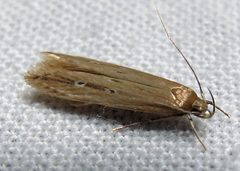
Limnaecia phragmitella, commonly known as the Shy Cosmet , is a small micro-moth in the Cosmopterigidae. have a wingspan of 15–22 mm with ochre-coloured forewings bearing distinctive grey-brown markings and white-edged spots. The is widespread across Europe, Asia, Australia, New Zealand, and North America. Larvae are more frequently encountered than adults, mining within the seed and stems of bulrushes (Typha species).
Pronunciation
How to pronounce Limnaecia phragmitella: /lɪmˈniːʃə fræɡmɪˈtɛlə/
These audio files are automatically generated. While they are not always 100% accurate, they are a good starting point.
Identification
Distinguished from similar small ochreous by the combination of two grey-brown white-edged spots on the forewing connected by a line, the grey-brown anal fold line with preceding white spot, and the series of whitish dots. Larval presence indicated by seed down hanging from bulrush seed due to silk binding. Male genitalia with strongly asymmetrical brachia and valvellae provide definitive identification.
Images
Appearance
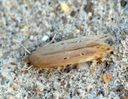
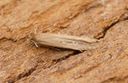
Small with wingspan 15–22 mm. ochre-coloured; yellowish-white with brown rings and almost white area. and tegulae ochre. Forewings ochre with pale yellow ; indistinct grey-brown line follows anal fold with elongated white spot distally; two grey-brown white-edged spots in middle of wing (inner spot before halfway, outer at 3/4 length), connected by grey-brown line from wing base; apical area with grey-brown veining occasionally outlined in white; series of whitish dots along apex; fringe pale ochre, more yellowish towards inner edge. Hindwings grey. brownish-grey with yellowish-white bands on segments.
Habitat
Fens and marshes; wet areas supporting stands of bulrush (Typha ).
Distribution
Europe (widespread including UK), Asia, Australia, New Zealand, and North America (Nova Scotia to Virginia, west to Oklahoma, north to Ontario).
Seasonality
active July in western Europe; June to August in North America.
Host Associations
- Typha latifolia - larval foodplantBulrush; larvae mine in seed and stems
- Typha angustifolia - larval foodplantLesser Bulrush; larvae mine in seed and stems
Life Cycle
Early instar larvae mine within leaf before moving to seed ; later instars occupy seed heads and stems of bulrushes. Larval silk binds seed down, preventing wind .
Behavior
Larvae produce silk that prevents seed down by wind; this silk binding makes larval presence detectable by the characteristic appearance of down hanging from seed . described as 'shy' in , though specific behavioral basis for this is not documented in sources.
Ecological Role
Larval feeding within bulrush seed may influence seed production and dynamics in wetland .
Similar Taxa
- Other Limnaecia speciesSimilar size and general appearance; distinguished by specific forewing spot pattern and genitalia structure
- Other CosmopterigidaeMany small ochreous micro- in ; L. phragmitella distinguished by characteristic two-spot forewing pattern with connecting line and association with Typha
More Details
Genome sequencing
sequenced as part of Darwin Tree of Life project; genome derived from male specimen collected in UK.
Larval detectability
Larvae are more readily found than due to visible silk-bound seed down on bulrush .