
Cosmopterix pulchrimella
Chambers, 1875
Beautiful Cosmopterix Moth
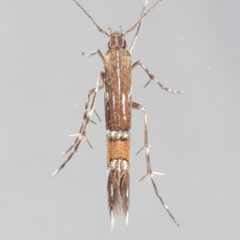
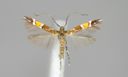
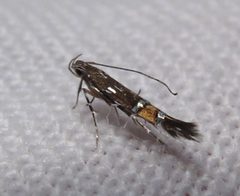
Cosmopterix pulchrimella is a small in the Cosmopterigidae, with a forewing length of 3.0–4.0 mm. It is distinguished by striking wing patterns including silver streaks, a bright orange transverse fascia, and metallic markings. The has a transatlantic distribution, occurring in North America and across the Palearctic region. Larvae are leaf miners that feed on plants in the Urticaceae family.
Pronunciation
How to pronounce Cosmopterix pulchrimella: //ˌkɒzməˈpɛtrɪks pʊlˈkrɪmɛlə//
These audio files are automatically generated. While they are not always 100% accurate, they are a good starting point.
Identification
The combination of very small size (3–4 mm forewing length), three silver streaks in the forewing basal area, bright orange transverse fascia with metallic golden borders, and specific patterning distinguishes this from other Cosmopterix. The white costal streak and white spot in the cilia are additional diagnostic features. Some North American specimens show darkened or absent orange fascia, which may cause confusion but the silver streaks and metallic markings remain consistent. The black and prothoracic plate of the larva, combined with greyish white body and the presence of black pellets on leaf undersides, aid in larval identification.
Images
Habitat
Associated with supporting its plants in the Urticaceae . In North America, found in areas where Parietaria pensylvanica and Pilea pumila occur. In the Palearctic region, associated with Parietaria judaica and Parietaria officinalis in Mediterranean and temperate zones. The has been recorded from the Azores, Canary Islands, and Madeira, indicating for insular environments.
Distribution
Native to North America and the Palearctic region. In North America: United States (Massachusetts, Michigan, southern Wyoming south to southern Florida, southern Arizona, and New Mexico) and Canada. In the Palearctic: Mediterranean Basin from Portugal to western Transcaucasus, north to Switzerland and Hungary. Also recorded from the Azores, Canary Islands, and Madeira. Recently found in southern England, representing range expansion.
Seasonality
(two per year). on wing throughout the year in southern areas of its range.
Diet
Larval plants: Parietaria judaica, Parietaria officinalis, Parietaria pensylvanica, and Pilea pumila ( Urticaceae). Larvae mine leaves of host plants.
Host Associations
- Parietaria judaica - larval Palearctic distribution
- Parietaria officinalis - larval Palearctic distribution
- Parietaria pensylvanica - larval North American distribution
- Pilea pumila - larval North American distribution
Life Cycle
. Larval stage: mines leaves of plants, starting as irregular gallery at midrib and expanding to irregular blotch. Larva constructs silk-lined gallery as shelter when not feeding. partly retained in mine but mostly ejected through hole at mine beginning, appearing as black pellets on leaf underside. Cocoon formed inside mine. : throughout the year in southern areas.
Behavior
Larval mining creates irregular galleries that lead to blotches, with silk spinning that often causes leaf contortion. Larvae frequently abandon mines and construct new ones. When not feeding, larvae retreat to silk-lined galleries. ejection behavior produces visible black pellets on leaf undersides that indicate larval presence.
Ecological Role
on Urticaceae ; specific ecological role beyond herbivory not documented.
Human Relevance
Subject of entomological study due to transatlantic distribution pattern and recent range expansion into southern England. Not known to be of economic importance.
Similar Taxa
- Other Cosmopterix speciesMany Cosmopterix share small size and metallic wing markings; C. pulchrimella is distinguished by the specific pattern of three silver streaks, orange fascia with metallic borders, and segment patterning described in the original description.
More Details
Nomenclature
Described by Chambers in 1875. The specific epithet 'pulchrimella' refers to the beautiful appearance of the .
Distribution notes
Recent detection in southern England suggests ongoing range expansion in the Palearctic, possibly climate-mediated.