Cosmopterix montisella
Chambers, 1875
Cosmopterix montisella is a small in the Cosmopterigidae, characterized by distinctive metallic bronze-brown forewings with complex white streaks and orange-brown transverse fasciae. have forewings 5.1–6.5 mm in length. The exhibits geographic variation in voltinism: across most of its range with adults active June through September, but in southern Arizona with additional late September .
Pronunciation
How to pronounce Cosmopterix montisella: /kɒzˈmɒptərɪks mɒnˈtɪsɛlə/
These audio files are automatically generated. While they are not always 100% accurate, they are a good starting point.
Identification
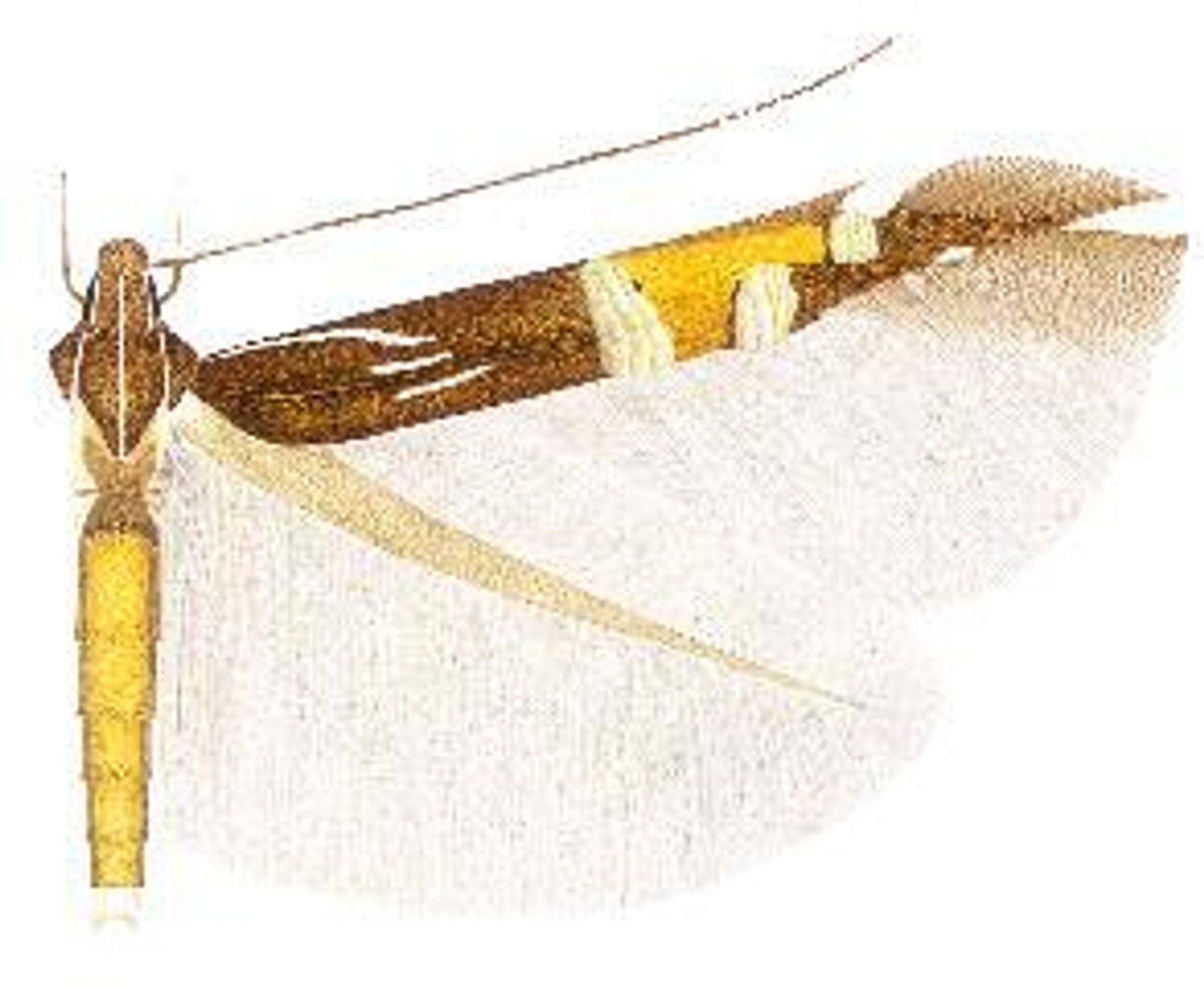
Distinguished from by combination of: four white streaks in forewing basal area (subcostal strongly bending from and widening distally); broad orange-brown transverse fascia beyond middle with tubercular silver or pale golden metallic borders; metallic spot approximately twice size of costal spot and much closer to base; broad white costal streak originating from costal spot. Variable characters include length and shape of white basal streaks and degree of interruption of metallic line. Male and female externally similar.
Images
Appearance
Small with forewings 5.1–6.5 mm. : pale ochreous with greenish and reddish reflections; vertex and neck tufts dark bronze brown with greenish and reddish gloss, edged white laterally and medially; collar dark bronze brown. Labial palpus with first segment short and ochreous, second segment four-fifths length of third and dark brown with white longitudinal lines, third segment white with dark brown lateral lines. dark brown with variable white markings from base. and tegulae dark bronze brown with greenish and reddish gloss; thorax with white line, tegulae lined white inwardly. Legs dark brown with reddish gloss; foreleg grey, midleg and hindleg femora pale golden; foreleg tibia and tarsal segments one and two with white line; midleg and hindleg tibiae with white oblique basal and medial lines and white rings. Forewing dark bronze brown with reddish golden gloss, bearing four white streaks in basal area (subcostal from base to one-quarter bending from and widening distally, short medial ending at or beyond subcostal, slightly longer than medial, narrow from beyond base to one-seventh); broad orange-brown transverse fascia beyond middle, at costa twice width of dorsum; inner edge bordered by broad tubercular silver or pale golden metallic fascia widening towards dorsum; outer edge bordered by two tubercular silver or pale golden metallic costal and dorsal spots (dorsal spot twice size of costal, closer to base); broad white costal streak from costal spot; pale golden to golden metallic apical line on dorsum, often interrupted, becoming broad white streak in apical cilia. Cilia dark bronze brown around apex, ochreous-brown on dorsum towards base. Hindwing brownish-grey with ochreous-brown cilia. dorsally brownish yellow, laterally and ventrally dark grey with broad white bands on segments; anal tuft ochreous-white dorsally, mixed brown ventrally.
Distribution
United States: from New York and Oregon south to New Mexico, Arizona and California. Disjunct records from Arkansas, Iowa, and Vermont. Established in Michigan.
Seasonality
active early June to mid-September where . In southern Arizona, with adults in July, August, and late September.
Life Cycle
throughout much of range; in southern Arizona.
More Details
Voltinism variation
The demonstrates latitudinal variation in number, with single in northern and central portions of range and two broods in southern Arizona. This pattern correlates with extended favorable conditions in lower latitudes.