
Cosmopterix attenuatella
(Walker, 1864)
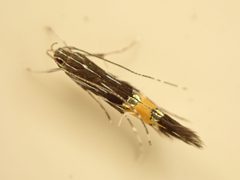
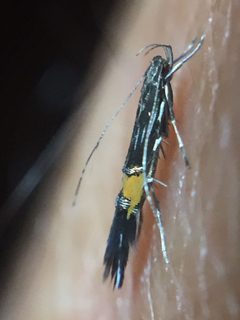
Cosmopterix attenuatella is a small in the Cosmopterigidae, first described by Francis Walker in 1864. It exhibits an exceptionally broad geographic distribution spanning tropical and subtropical regions across both the Old and New World. The is notable for its leaf-mining larvae that feed on grasses and sedges. are diminutive, with a wingspan of approximately 9 mm.
Pronunciation
How to pronounce Cosmopterix attenuatella: /kɔzˈmɒptərɪks ætˌtɛnjuˈætəllə/
These audio files are automatically generated. While they are not always 100% accurate, they are a good starting point.
Identification
The can be distinguished from by its exceptionally broad pantropical distribution combined with specific larval associations. Accurate identification to species level requires examination of genitalia or molecular analysis, as external overlaps with other Cosmopterix species. The small size (9 mm wingspan) and association with Poaceae and Cyperaceae hosts may aid in field recognition where these plants are present.
Images
Appearance
are minute with a wingspan of approximately 9 mm. The body and wing patterning are characteristic of the Cosmopterix, though specific coloration details are not well documented in available sources.
Habitat
Occupies tropical and subtropical environments where plants occur. Larval development requires presence of Poaceae (grasses) and Cyperaceae (sedges), suggesting open, grassy, or wetland-edge . Specific microhabitat preferences for are undocumented.
Distribution
Pantropical and pantropical-subtropical distribution spanning: North America (United States, Bermuda), Caribbean (Cayman Islands, Virgin Islands, Dominica, Jamaica, Puerto Rico, Trinidad and Tobago), Central and South America ( Rica, Brazil, Ecuador, Peru, Argentina), Atlantic islands (Canary Islands, Madeira, Galápagos Islands, Saint Helena), Pacific islands (Cook Islands), Asia (Taiwan, China, Japan), Oceania (Australia, New Zealand), and Africa/Madagascar region (Madagascar, Seychelles, Mauritius, Democratic Republic of Congo).
Diet
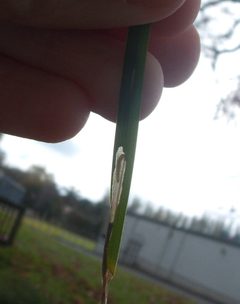
Larvae are leaf miners that feed internally on leaves of Poaceae (specifically Melinus minutiflora), Cyperus rotundus, and Scirpus . feeding habits are unknown.
Host Associations
- Melinus minutiflora - larval Poaceae;
- Cyperus rotundus - larval Cyperaceae;
- Scirpus - larval Cyperaceae;
Life Cycle
Complete with leaf-mining larval stage. Larvae construct internal mines in leaves of plants. likely occurs within or near the larval mine, though specific details are undocumented.
Behavior
Larvae exhibit leaf-mining , feeding internally within plant leaves rather than externally. behavior patterns are not documented.
Ecological Role
As a , larvae may contribute to nutrient cycling through herbivory on grasses and sedges. impacts on plants are likely minimal given the small size of individual larvae and mines.
Human Relevance
No documented economic or medical significance. The has been recorded in agricultural settings where plants (including Cyperus rotundus, a widespread weed) occur, but is not considered a pest of cultivated crops.
Similar Taxa
- Cosmopterix speciesNumerous share similar small size, wing patterning, and leaf-mining habits on monocots; accurate separation requires dissection or
More Details
Taxonomic history
Described by Francis Walker in 1864, with the epithet 'attenuatella' reflecting the slender or attenuate appearance typical of the .
Distribution significance
The demonstrates one of the broadest geographic ranges within the Cosmopterigidae, spanning multiple continents and oceanic island systems. This distribution pattern suggests either strong capacity or historical human-mediated transport, though the mechanism remains unstudied.