
Coleophora pruniella
Clemens, 1861
cherry casebearer moth, cherry casebearer
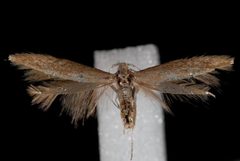
Coleophora pruniella is a small casebearer moth in the Coleophoridae, commonly known as the cherry casebearer moth. The is native to North America and is recognized by its larval habit of constructing portable cases from silk and plant material. Larvae are , feeding on leaves of numerous woody plant . The species serves as a for the Microbracon pygmaeus.
Pronunciation
How to pronounce Coleophora pruniella: /koʊliˈɒfərə pruːniˈɛlə/
These audio files are automatically generated. While they are not always 100% accurate, they are a good starting point.
Identification
The combination of small size (wingspan ~11 mm), narrow wings, and association with larval case-bearing distinguishes this from most other small . Within Coleophoridae, species-level identification typically requires examination of genitalia or larval case characteristics; the specific epithet and suggest association with Prunus , though this alone is insufficient for definitive identification.
Images
Appearance
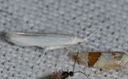
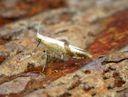
are small with a wingspan of approximately 11 mm. As with other Coleophora , adults have narrow, elongated wings and a slender body. Larvae construct distinctive portable cases from silk combined with plant material, a defining trait of the Coleophoridae.
Distribution
North America: recorded from New York, Oklahoma, Utah, Ontario, British Columbia, Alberta, Manitoba, and Saskatchewan.
Diet
Larvae feed on leaves of Prunus, Rosa, Amelanchier, Betula, Alnus, Juglans, Myrica, Comptonia, Salix, Populus, and Fraxinus .
Host Associations
- Microbracon pygmaeus - ; important agent
- Prunus - larval plantImplied by ; confirmed as larval food plant
- Rosa - larval plantLarval food plant
- Amelanchier - larval plantLarval food plant
- Betula - larval plantLarval food plant
- Alnus - larval plantLarval food plant
- Juglans - larval plantLarval food plant
- Myrica - larval plantLarval food plant
- Comptonia - larval plantLarval food plant
- Salix - larval plantLarval food plant
- Populus - larval plantLarval food plant
- Fraxinus - larval plantLarval food plant
Behavior
Larvae construct portable cases from silk and plant material, which they carry while feeding. This case-bearing is characteristic of the Coleophoridae and provides protection during larval development.
Ecological Role
Serves as for the Microbracon pygmaeus, supporting parasitoid that may contribute to regulation of populations.
Human Relevance
Larvae feed on economically and ecologically important woody plants including cherry (Prunus), rose (Rosa), birch (Betula), alder (Alnus), walnut (Juglans), willow (Salix), poplar (Populus), and ash (Fraxinus), suggesting potential as a minor pest or target for .
Similar Taxa
- Other Coleophora speciesShare case-bearing larval and small size; require genitalia examination or /larval case analysis for differentiation
- Other Gelechioidea familiesSmall size and narrow wings overlap, but Coleophoridae distinguished by larval case construction