
Epermeniidae
fringe-tufted moths
Genus Guides
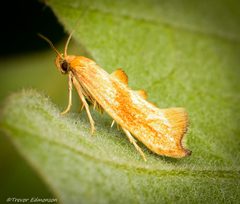
2, commonly called fringe-tufted moths, is a of small Lepidoptera containing approximately 14 . The family is placed in its own superfamily Epermenioidea, though its systematic position among the apoditrysian group "Obtectomera" remains uncertain. Members are characterized by distinctive projecting tufts on the inner margin of the hindwing and of bristles on the legs. The group has been extensively revised by Dr. Reinhard Gaedike, with major genera including Epermenia, Ochromolopis, and Gnathifera.
Pronunciation
How to pronounce Epermeniidae: /ˌɛpərˌmiːniˈaɪdiː/
These audio files are automatically generated. While they are not always 100% accurate, they are a good starting point.
Identification
Small narrow-winged with wingspan of 7–20 mm. Most easily distinguished by projecting tufts on the inner margin of the hindwing. Legs bear conspicuous of bristles (spines). smoothly scaled, lacking ocelli and chaetosemata. lacks spines. Most similar to Stathmopodinae (Oecophoridae), which differ in having of forelegs and midlegs without whorls of spines and a scaled at the base.
Images
Habitat
Worldwide in temperate and tropical regions, with particular abundance in montane areas.
Distribution
distribution spanning Palaearctic, Indo-Australia, Pacific islands, Australia to New Caledonia, and the Afrotropics (though sparsely documented there).
Host Associations
- Apiaceae - plantMany European feed on umbels; Epermenia chaerophyllella is a pest of cultivated species
- Santalaceae - plantIncludes Australian quandong
- Loranthaceae - plantParasitic plant
- Pinaceae - plant
- Pittosporaceae - plant
- Leguminosae - plant
- Angelica pubescens - plantFor Epermenia sinjovi
- Angelica ursina - plantFor Epermenia sinjovi
- Angelica polymorpha - plantNew record for Epermenia sinjovi in China
Life Cycle
Caterpillars feed inside plant parts including fruits, seeds, galls, leaves, or flowers, sometimes in mines, sometimes exposed or under silk on leaf surfaces. occurs within a fine open-network cocoon on the plant or among ground debris; the pupa is not extruded from the cocoon.
Behavior
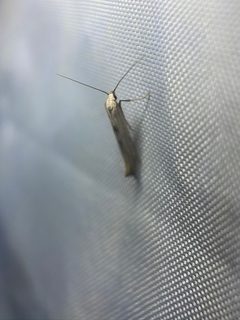
are and well-camouflaged. At rest, they position themselves parallel to the surface with wings held tent-like over the back.
Human Relevance
Epermenia chaerophyllella is a documented pest of cultivated Apiaceae .
Similar Taxa
- Stathmopodinae (Oecophoridae)Similar small narrow-winged , but distinguished by of forelegs and midlegs lacking of spines, and scaled at the base
- Alucitoidea (plume moths)Share morphological similarities in wing fringe groups, though not closely related
- Pterophoroidea (plume moths)Share morphological similarities in wing fringe groups, though not closely related
- SchreckensteinioideaShare spiny legs and open-network cocoon characteristics with some
Sources and further reading
- BugGuide
- Wikipedia
- GBIF taxonomy match
- iNaturalist taxon
- NCBI Taxonomy
- Catalogue of Life
- Nota Lepidopterologica goes advanced open access with Pensoft Publishers | Blog
- Uncategorized | Blog - Part 22
- Pensoft Editorial Team | Blog - Part 126
- New data on the taxonomy, distribution and host plants of Australian Epermeniidae (Lepidoptera: Epermenioidea)
- Two new species of the genus Epermenia Hübner, [1825] and some new distributional and taxonomic records (Lepidoptera: Epermeniidae)
- New taxa and new records of Afrotropical Epermeniidae (Lepidoptera) with a distributional checklist
- Out of East Asia: Epermenia sinjovi Gaedike, 1993 (Lepidoptera, Epermeniidae) newly recorded from the European Alps
- New species of Epermeniidae from Africa with a distributional checklist of the family for the Afrotropical Region (Lepidoptera: Epermenioidea)
- New record of Epermenia (Calotripis) sinjovi Gaedike (Lepidoptera: Epermeniidae) in China: DNA barcode, adult, immature stages, host plant and biology
- An overview of the Romanian Epermeniidae (Lepidoptera, Epermenioidea) summarizing the current knowledge in an annotated checklist
- Host ranges of parasitoids (Hymenoptera: Braconidae and Ichneumonidae) reared fromEpermenia chaerophyllella(Goeze) (Lepidoptera: Epermeniidae) in Britain, with description of a new species ofTriclistus(Ichneumonidae)
- The genome sequence of the Common Ridge-back moth, Epermenia chaerophyllella (Goeze, 1783) (Lepidoptera: Epermeniidae).