
Eudeilinia herminiata
(Guenée, 1857)
Northern Eudeilinia, Northern Eudeilinia Moth
Eudeilinia herminiata is a North American hook-tip in the Drepanidae, described by Guenée in 1857. It ranges across much of the continent from British Columbia to Newfoundland, south to Florida and Texas. The is associated with deciduous woodland and has a single with active from spring through late summer.
Pronunciation
How to pronounce Eudeilinia herminiata: /ˌjuːdɛɪˈlɪniə ˌhɜːrmɪniˈɑːtə/
These audio files are automatically generated. While they are not always 100% accurate, they are a good starting point.
Identification
The combination of small size (25–30 mm wingspan), pale coloration with fine wavy transverse lines, and association with deciduous woods helps distinguish this from similar Drepanidae. The single with extended period (April–September) is a useful phenological cue. Larval association with Cornus (dogwood) species provides additional diagnostic context where plants are known.
Images
Appearance
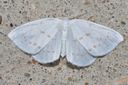
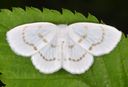
have a wingspan of 25–30 mm. The forewings are pale with fine, wavy transverse lines and a subtle pattern of darker shading. The hindwings are similarly pale with delicate markings. The overall coloration is muted, blending with bark and leaf litter.
Habitat
Deciduous woods and wood edges. The appears to require mature or semi-mature deciduous forest conditions.
Distribution
North America: British Columbia to Newfoundland, south to Florida, west to Texas. Additional records from Alberta, Manitoba, and Saskatchewan in Canada, and Vermont in the United States.
Seasonality
are active from April to September. One per year.
Diet
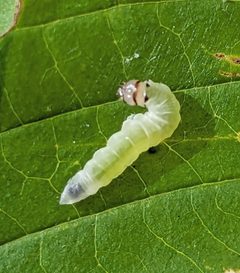
Larvae feed on Cornus (dogwoods). feeding habits are not documented.
Host Associations
- Cornus - larval food plantSpecific Cornus not distinguished in available sources
Life Cycle
One per year. Larval development occurs on Cornus plants. details are not documented. emerge in spring and persist through summer.
Behavior
are and attracted to light. Extended period suggests potential for long adult longevity or staggered , though this has not been explicitly studied.
Ecological Role
Larval herbivore on native Cornus . Specific ecological impacts or are not documented.
Human Relevance
Occasionally encountered by enthusiasts and in biodiversity surveys. Not known to be of economic importance. No documented pest status.
Similar Taxa
- Other Eudeilinia species Eudeilinia contains multiple North American that may overlap in range and general appearance; precise identification requires examination of genitalia or association data
- Other small DrepanidaePale coloration and fine line patterns are shared with several Drepanidae ; size and association help narrow possibilities
More Details
Original description
First described as Corycia hermineata by Achille Guenée in 1857, later transferred to Eudeilinia
Observation frequency
Relatively well-documented on citizen science platforms with over 1,500 iNaturalist observations, suggesting it is not rare within its range