
Tebenna onustana
Walker, 1864
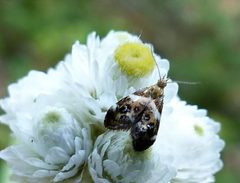
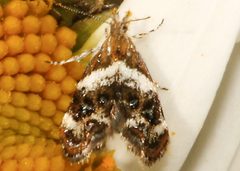
Tebenna onustana is a small in the Choreutidae, first described by Francis Walker in 1864. It occurs in northeastern North America, with records from Ontario, Quebec, Vermont, and surrounding regions of the United States. As a member of Choreutidae, it belongs to a family of small, often iridescent moths commonly known as metalmark moths.

Pronunciation
How to pronounce Tebenna onustana: /tɛˈbɛnə oʊˈnʌsˌtænə/
These audio files are automatically generated. While they are not always 100% accurate, they are a good starting point.
Identification
Choreutidae are generally small with broad, often triangular wings and frequently display metallic or iridescent scaling. Within the Tebenna, may be distinguished by wing pattern, genitalia , and geographic distribution. T. onustana is separable from western by its eastern North American range.
Images
Distribution
Eastern North America: recorded from Ontario and Quebec in Canada, and the northeastern United States including Vermont.
Similar Taxa
- Tebenna gemmalisOverlaps in but occurs in western North America; distinguished by geographic range and subtle wing pattern differences.
- Other Choreutidae generaMay resemble T. onustana in size and general form; Tebenna often share the characteristic resting posture with wings held tent-like or flat, but genitalia examination is required for definitive identification.
More Details
Taxonomic authority
The was originally described by Francis Walker in 1864, a prolific but sometimes controversial 19th-century entomologist. The specific epithet 'onustana' derives from Latin.
Observation frequency
iNaturalist records indicate 233 observations, suggesting the is encountered with moderate frequency by naturalists in its range, though it remains poorly documented in formal literature.