
Tegeticula maculata
(Riley, 1881)
Chaparral yucca moth
Tegeticula maculata is a small in the Prodoxidae, commonly known as the chaparral yucca moth. It is the sole of Hesperoyucca whipplei, forming an obligate mutualism in which the moth's larvae feed exclusively on developing seeds of this plant. The exhibits high genetic structure across its range with limited morphological divergence, suggesting ancient lineage sorting rather than recent speciation.
Pronunciation
How to pronounce Tegeticula maculata: //ˌtɛɡəˈtɪkjuːlə ˌmækjʊˈleɪtə//
These audio files are automatically generated. While they are not always 100% accurate, they are a good starting point.
Identification
Distinguished from other Tegeticula by its exclusive association with Hesperoyucca whipplei rather than Yucca species. maculata and extranea occupy different geographic ranges and show some morphological differentiation. Genetic analysis reveals deep mitochondrial splits within the species, with subspecies in separate clades and additional structure within subspecies maculata.
Images
Appearance
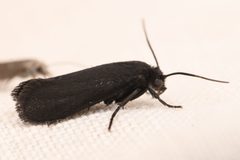
Small with wingspan of 16–23 mm for maculata. Morphologically variable within the , with subspecies maculata and extranea showing some differentiation.
Habitat
Coastal chaparral and montane dry shrubby grassland. patchiness has increased postglacially due to restricted distribution of the exclusive plant.
Distribution
North America: central-southern cismontane California, Sierra Nevada north to Fresno County, north-western Arizona, and Baja California Norte to the Vizcaino region.
Seasonality
activity coincides with flowering of Hesperoyucca whipplei. Females emerging near the end of the flowering season may oviposit in developing seed pods rather than open flowers.
Diet
Larvae feed exclusively on developing seeds of Hesperoyucca whipplei. do not feed.
Host Associations
- Hesperoyucca whipplei - obligateExclusive plant; sole of this
Life Cycle
Females oviposit in the ovaries of yucca flowers, depositing near fertilized ovules. Larvae develop within seed pods, feeding on developing seeds. occurs in soil.
Behavior
Female actively collect pollen with specialized tentacles from mouthparts, form it into a ball, and transport it to stigma of another flower. They consistently fly to a different plant after collecting pollen, ensuring cross-. After depositing the first in a flower, females always pollinate that flower, though not necessarily after subsequent ovipositions. Females emerging late in the season frequently oviposit in developing seed pods rather than open flowers.
Ecological Role
Obligate of Hesperoyucca whipplei. The mutualism is essential for plant , as the plant's pollen is too heavy for wind and the is the only pollinator. The plant reciprocates by providing seeds for larval development.
Similar Taxa
- Tegeticula syntheticaPollinates western Joshua tree (Yucca jaegeriana); distinguished by plant association and slightly larger size (9 mm vs. 6 mm for T. antithetica, though T. maculata is 16–23 mm)
- Tegeticula antitheticaPollinates eastern Joshua tree (Yucca jaegeriana); smaller than T. synthetica (6 mm vs. 9 mm), distinguished by plant association and ovipositor length matching host flower
More Details
Genetic structure and phylogeography
Phylogeographic analysis reveals high genetic structure with limited speciation. The two (maculata and extranea) form separate mitochondrial clades, but there is an equally deep split within subspecies maculata. No evidence for among regions. This pattern is explained by historical biogeographic boundaries and increasingly patchy postglacial distribution of the plant.
Coevolutionary dynamics
The represents an ancient lineage within yucca moths that has undergone little diversification compared to younger, rapidly diversifying lineages. Gross morphological divergence is limited to the very old split between , despite substantial genetic differentiation and local potential in the absence of .
Subspecies
Two recognized : Tegeticula maculata maculata and Tegeticula maculata extranea (Edwards, 1888), occupying different portions of the range with some morphological differentiation.
Sources and further reading
- BugGuide
- Wikipedia
- GBIF taxonomy match
- iNaturalist taxon
- NCBI Taxonomy
- Catalogue of Life
- Be careful around baldfaced hornets, Dolichovespula maculata — Bug of the Week
- An inside look at baldfaced hornets, Dolichovespula maculata — Bug of the Week
- High fiber diets for baldfaced hornets? Nah, construction materials for enlarging nests: Baldfaced hornets, Dolichovespula maculata — Bug of the Week
- What do insects do in winter, Part 2? Tolerating the big chill: Banded woolly bears, Pyrrharctia isabella, field crickets, Gryllus spp., baldfaced hornets, Dolichovespula maculata, and others — Bug of the Week
- Bug Eric: Window-winged Moths
- Unique Relationship Between Joshua Tree and Moth Documented for First Time
- Phylogeography of the yucca moth Tegeticula maculata: the role of historical biogeography in reconciling high genetic structure with limited speciation
- Oviposition and pollination behavior of the yucca moth, Tegeticula maculata (Lepidoptera: Prodoxidae), and its relation to the reproductive biology of Yucca whipplei (Agavaceae)