
Prodoxus y-inversus
Riley, 1892
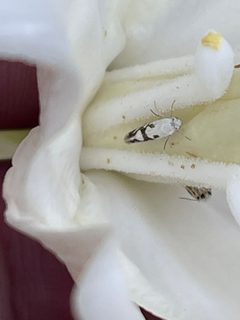
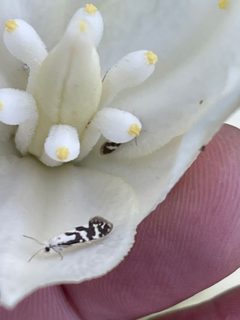
Prodoxus y-inversus is a small yucca moth in the Prodoxidae, restricted to the southwestern United States. are active in spring and possess a wingspan of 11–16 mm. The is intimately associated with Yucca baccata and Yucca schottii, on which its larvae feed.
Pronunciation
How to pronounce Prodoxus y-inversus: /prəˈdɒksəs waɪ ɪnˈvɜːrsəs/
These audio files are automatically generated. While they are not always 100% accurate, they are a good starting point.
Identification
Distinguished from other Prodoxus by its restricted geographic range in the southwestern United States and its specific association with Yucca baccata and Yucca schottii. The specific epithet 'y-inversus' may refer to a diagnostic wing marking, though this is not confirmed in available sources.
Images
Appearance
Small with wingspan of 11–16 mm. Specific coloration and pattern details are not documented in available sources.
Habitat
Shrubby desert and open forests in the southwestern United States.
Distribution
Southwestern New Mexico, southeastern Arizona, and southern Nevada, United States.
Seasonality
are active from April to May.
Diet
Larvae feed on Yucca baccata and Yucca schottii. feeding habits are not documented.
Host Associations
- Yucca baccata - larval food plant
- Yucca schottii - larval food plant
Ecological Role
As a yucca moth, participates in the obligate pollination mutualism with yucca plants, though the specific role of P. y-inversus in pollination versus seed is not documented. Larval feeding on yucca seeds represents a form of herbivory.
Similar Taxa
- Other Prodoxus speciesShare the same and general yucca-associated ; distinguished by plant specificity and geographic distribution.
- Tegericula speciesOther yucca moths in the same ; Tegericula are generally larger and have different wing venation and associations.
More Details
Taxonomic note
The specific epithet was originally published as 'y-inversum' (neuter, matching the Prodoxus which was treated as neuter at the time), but is now treated as 'y-inversus' under current gender agreement rules.
Conservation status
Not evaluated; known from only four iNaturalist observations, suggesting it may be genuinely rare or underreported.