
Lamproniinae
Heslop, 1938
Genus Guides
1- Lampronia(currant moths)
Lamproniinae is a of small within the Prodoxidae (order Lepidoptera). These insects are part of the superfamily Adeloidea, which includes primitive moth lineages. The subfamily contains relatively few , most notably including the Lampronia. Members are characterized by reduced wing venation and are associated with specific plants, particularly in the Rosaceae family.
Pronunciation
How to pronounce Lamproniinae: /læmˈprəʊni.aɪniː/
These audio files are automatically generated. While they are not always 100% accurate, they are a good starting point.
Identification
Distinguished from other Prodoxidae by the combination of narrow forewings and reduced hindwing venation with fewer than five reaching the margin. Differs from Adelinae (fairy moths) by less extreme wing narrowing and absence of the greatly elongated found in some adelines. Separated from Prodoxinae (yucca moths) by smaller size, lack of specialized pollen-carrying mouthparts, and different associations. Genitalia examination often required for definitive identification; male genitalia with distinctive valvae structure, female with reduced ovipositor compared to Prodoxinae.
Images
Appearance
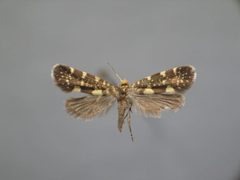
Small with wingspan generally under 15 mm. Forewings narrow and , often with metallic or iridescent scaling. Hindwings markedly narrower than forewings with reduced venation. simple or slightly serrate, not strongly bipectinate. Body slender with smooth scaling. Wing pattern typically subdued with longitudinal streaks or faint mottling rather than bold markings.
Habitat
Associated with temperate woodland edges, hedgerows, and scrubland where plants in Rosaceae occur. Larval include stems, roots, and fruits of herbaceous and woody Rosaceae. found in shaded, humid microhabitats near larval food sources.
Distribution
Primarily Palearctic distribution, with greatest diversity in Europe and western Asia. Records extend from the British Isles and Scandinavia eastward through Russia to Central Asia. Some reach the Mediterranean region. Absent from North America, where related Prodoxidae lineages occur instead.
Seasonality
active primarily in late spring to early summer (May–July in temperate regions), with some showing bimodal . Larval feeding occurs through summer and autumn, with typically as larvae or pupae in plant tissues.
Diet
Larvae feed internally on tissues of Rosaceae plants, including stems, roots, fruits, and flower buds. Documented hosts include Rubus (brambles), Prunus, and Rosa . do not feed; mouthparts reduced or non-functional.
Host Associations
- Rubus - larval food plantstem and root boring
- Prunus - larval food plantfruit and flower feeding
- Rosa - larval food plantstem boring
Life Cycle
Holometabolous development with complete . laid on or near plant tissues. Larvae bore into stems, roots, or fruits, feeding internally and creating galleries. occurs within the larval gallery or in soil. No in some ; single per year typical, though some may show partial second generation in favorable conditions.
Behavior
or in shaded conditions, with weak and tendency to remain close to vegetation. Larvae are concealed feeders, spending entire development within host plant tissues. No known social or . Adults do not visit flowers for nectar.
Ecological Role
Larvae act as stem and root borers in Rosaceae, creating entry points for secondary and contributing to nutrient cycling through plant tissue decomposition. densities generally low, limiting impact on plant . Serve as prey for and predatory insects.
Human Relevance
Minimal direct economic impact. Occasionally reported as minor pests in Rubus , though damage rarely significant. Of interest to lepidopterists due to phylogenetic position as primitive lineage. No known cultural or traditional uses.
Similar Taxa
- AdelinaeAlso in Adeloidea with narrow wings, but Adelinae have more extremely slender wings, often with greatly elongated in males, and different associations (often Boraginaceae or other )
- ProdoxinaeSister within Prodoxidae; distinguished by larger size, specialized pollen-carrying in yucca moths, and obligate pollination mutualism with Yucca rather than Rosaceae herbivory
- IncurvariinaeRelated primitive with case-bearing larvae; differ in larval habit of constructing portable cases and generally broader wing shape
More Details
Taxonomic History
Established by Heslop in 1938, with classification historically unstable. Some treatments have considered Lamproniinae as a separate or merged with other groups. Molecular supports its placement as of Prodoxidae.
Phylogenetic Significance
Lamproniinae represents a transitional lineage between the more derived yucca moths (Prodoxinae) and other Adeloidea, providing insights into evolution of lepidopteran-plant interactions.