
Zethus
Fabricius, 1804
mason wasps, potter wasps
Species Guides
5- Zethus guerreroi
- Zethus miscogaster
- Zethus montezuma
- Zethus slossonae(Slosson's Mason Wasp)
- Zethus spinipes
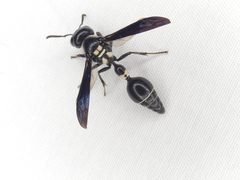
Zethus is the largest in the Eumeninae (potter and mason wasps), containing over 250 . The genus is predominantly Neotropical in distribution, with three recognized subgenera: Zethus (Zethus), Zethus (Zethusculus), and Zethus (Zethoides). Species are solitary and construct nests using diverse materials including mud, sand, vegetable matter, and insect parts. Many species are poorly known, with numerous described from only one sex.
Pronunciation
How to pronounce Zethus: //ˈzɛ.tʰus//
These audio files are automatically generated. While they are not always 100% accurate, they are a good starting point.
Identification
The is characterized by features of the pronotum and male genitalia; specific identification often requires examination of both sexes due to sexually dimorphic characters. Subgeneric classification relies on combinations of external morphological traits.
Images
Habitat
Nests are constructed in twigs, branches, and old insect burrows; some utilize pre-existing cavities in woody vegetation.
Distribution
Primarily Neotropical, with records from southern Brazil (Paraná), São Paulo state, Maranhão State in northeastern Brazil, south Florida, and the Lower Río Grande Valley. Some have been recorded in the Amazon Forest and Atlantic Forest fragments. The extends into the Oriental region, with the most northern records from China.
Seasonality
Nests have been founded between December and April in southern Brazil.
Life Cycle
Development from to has been observed to average 39 days in Zethus pilosus.
Behavior
Solitary nest construction; nests are built using combinations of mud, sand, vegetable matter, and insect parts. Partitions are constructed within nest cavities.
Sources and further reading
- BugGuide
- Wikipedia
- GBIF taxonomy match
- iNaturalist taxon
- NCBI Taxonomy
- Catalogue of Life
- Ecology and Taxonomy of Lower Río Grande Valley Zethus Ecology and Taxonomy of Lower Rio Grande Valley Zethus
- Zethus (Zethus) pilosus Zavattari, 1912 (Hymenoptera: Vespidae: Eumeninae) from Southern Brazil: description of the female, the male genitalia, its nest and notes on biology
- Mason Wasps of Florida, Zethus spp. (Insecta: Hymenoptera: Vespidae: Eumeninae)
- Figure 14 from: Tan J-L, Carpenter JM, van Achterberg C (2018) Most northern Oriental distribution of Zethus Fabricius (Hymenoptera, Vespidae, Eumeninae), with a new species from China. Journal of Hymenoptera Research 62: 1-13. https://doi.org/10.3897/jhr.62.23196
- Most northern Oriental distribution of Zethus Fabricius (Hymenoptera, Vespidae, Eumeninae), with a new species from China
- Figures 1-3 from: Tan J-L, Carpenter JM, van Achterberg C (2018) Most northern Oriental distribution of Zethus Fabricius (Hymenoptera, Vespidae, Eumeninae), with a new species from China. Journal of Hymenoptera Research 62: 1-13. https://doi.org/10.3897/jhr.62.23196
- First records of two Amazonian species of Zethus (Zethoides) Fox, 1899 (Hymenoptera, Vespidae, Eumeninae) in Atlantic Forest fragments in São Paulo state, Brazil
- A new species of Zethus Fabricius (Hymenoptera, Vespidae, Zethinae) from Northeast Brazil, with notes on morphology and distributional records of Z. alessandroi Lopes
- Figures 4-13 from: Tan J-L, Carpenter JM, van Achterberg C (2018) Most northern Oriental distribution of Zethus Fabricius (Hymenoptera, Vespidae, Eumeninae), with a new species from China. Journal of Hymenoptera Research 62: 1-13. https://doi.org/10.3897/jhr.62.23196