
Eumenes fraternus
Say, 1824
Fraternal Potter Wasp
Eumenes fraternus is a solitary potter wasp native to eastern North America. Females construct distinctive miniature mud pots as nests, provisioning each with paralyzed caterpillars before laying a single . The exhibits the characteristic long, slender first abdominal segment typical of its . feed primarily on nectar and are active from spring through late autumn.
Pronunciation
How to pronounce Eumenes fraternus: /ɛˈjuːməˌniːz frəˈtɜːrnəs/
These audio files are automatically generated. While they are not always 100% accurate, they are a good starting point.
Identification
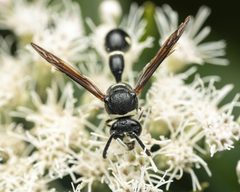
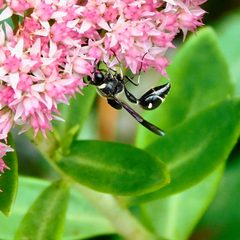
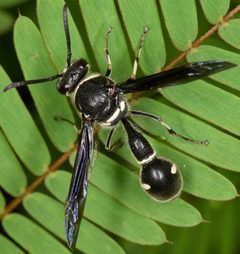
Distinguished from Eumenes crucifera and Eumenes verticalis by shorter on the first antennal segment. The combination of black coloration with ivory (not yellow) markings, together with the characteristic potter wasp body shape—elongate first abdominal segment creating a narrow 'waist'—separates it from other vespid . The mud nest, when found, is diagnostic: a small, urn-shaped pot with fluted neck, about the size of a marble.
Images
Appearance
Medium-sized , 15–20 mm in length, with black body and scattered ivory-colored markings. The first abdominal segment is long and slender, narrow anteriorly and widening posteriorly—a defining trait. Forewings measure 8–10.5 mm in males and 10–12.5 mm in females. Antennal first segment has shorter than similar E. crucifera and E. verticalis. Wings fold longitudinally when at rest.
Habitat
Occupies glades, rough shrubby areas, and forest edges. Nests are built in sheltered locations including recessed window frames, tree hollows, and occasionally exposed situations such as pine needles or hanging from vegetation.
Distribution
Eastern United States and Canada, ranging west to Ontario, Minnesota, Kansas, and Texas.
Seasonality
On the wing from approximately April to November in North Carolina; of from nests typically occurs the following spring or early summer if as pupae.
Diet
feed primarily on nectar and pollen; larvae consume paralyzed caterpillars (Lepidoptera larvae) provided by the female.
Life Cycle
Female constructs a pitcher-shaped mud nest, collecting water and soil particles to form damp mud boluses. She lays a single suspended by a silken thread inside the empty pot, then provisions the nest with multiple stung and paralyzed caterpillars. The pot is sealed with a mud plug. The larva hatches, consumes the living but immobilized prey, pupates within the pot, and emerges as an by chewing an exit hole in the side. Development may complete in weeks or extend through winter as a pupa.
Behavior
Solitary and non-aggressive. Females exhibit elaborate nest-building , completing one mud pot entirely before hunting. They may spend nights inside unfinished nest . do not defend nests aggressively.
Ecological Role
Functions as a natural agent of caterpillar . The provisioning of nests with specific prey may influence local lepidopteran structure.
Human Relevance
Generally beneficial due to caterpillar . Nests are sometimes considered unsightly when attached to buildings, but the pose minimal sting risk and do not defend nests aggressively. Nests are occasionally used in educational contexts to demonstrate insect architecture and solitary wasp .
Similar Taxa
- Eumenes cruciferaSimilar black-and-ivory coloration and body form; distinguished by longer on first antennal segment.
- Eumenes verticalisOverlapping range and general appearance; separated by longer on first antennal segment.
- Sceliphron caementarium (Black and Yellow Mud Dauber)Also builds mud nests, but constructs multi-cellular, clod-like structures rather than discrete urn-shaped pots; nests usually clustered and covered with additional mud layers.
- Trypoxylon politum (Pipe Organ Mud Dauber)Builds linear mud tubes rather than pot-shaped nests; often multiple parallel tubes attached to flat surfaces.
More Details
Nest Construction
Nest building requires several hundred mud fragments and may take one to two hours. The female collects water, then gathers dry soil particles, dampening them to form each bolus.
Sources and further reading
- BugGuide
- Wikipedia
- GBIF taxonomy match
- iNaturalist taxon
- NCBI Taxonomy
- Catalogue of Life
- Bug Eric: Mud Masterpieces
- Bug Eric: January 2010
- Bug Eric: Bee Flies
- Bug Eric: Wasp Wednesday: Walden's Mason Wasp, Ancistrocerus waldenii
- An Introduction to the Wonderful World of Wasps: Meet the Heath Sand Wasp - Buglife Blog - Buglife
- Bug Eric: April 2010