
Orthogonalys pulchella
(Cresson)
Orthogonalys pulchella is a of hyperparasitoid in the Trigonalidae. This species is part of a unique guild of that target the larvae of other parasitoid wasps rather than primary . The species was described by Cresson and has been documented in parts of North America.
Pronunciation
How to pronounce Orthogonalys pulchella: //ˌɔr.θəˈɡoʊ.nə.lɪs pʊlˈkɛl.lə//
These audio files are automatically generated. While they are not always 100% accurate, they are a good starting point.
Identification
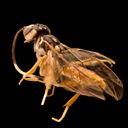
Members of the Orthogonalys can be distinguished from other trigonalid genera by the orthogonal (right-angled) arrangement of the forewing that gives the genus its name. Specific identification of O. pulchella requires examination of morphological details; the epithet 'pulchella' (meaning 'beautiful little one') suggests distinctive coloration or patterning.
Images
Distribution
Recorded from Canada (Ontario) and presumably other parts of North America based on the distribution of related in the .
Life Cycle
As a trigonalid , O. pulchella likely exhibits the 's characteristic hyperparasitoid : females lay on vegetation, where they are ingested by caterpillars (primary that are not themselves parasitized). The trigonalid egg remains until the caterpillar is subsequently parasitized by a primary wasp, at which point the trigonalid larva emerges and consumes the primary parasitoid larva.
Behavior
Trigonalid are known for their unusual 'scattershot' approach to location, depositing large numbers of minute on vegetation rather than targeting specific hosts directly. This passive strategy relies on chance ingestion by suitable host caterpillars.
Ecological Role
Functions as a tertiary consumer in , hyperparasitizing primary (primarily ichneumonids and braconids) that attack lepidopteran larvae. This positions trigonalids as unusual 'parasitoids of parasitoids' with complex indirect effects on herbivore .
Similar Taxa
- Other Trigonalidae genera (e.g., Trigonalys, Lycogaster)Share the hyperparasitoid and general body plan, but differ in wing venation patterns (Orthogonalys has the distinctive orthogonal forewing venation) and other morphological details.
More Details
Taxonomic history
The was originally described by Cresson, a prominent 19th-century American entomologist who described numerous hymenopteran .
Research significance
A 2009 paper in American Entomologist specifically examined the of O. pulchella, highlighting the unique 'scattershot' location strategy that makes trigonalids exceptional among .